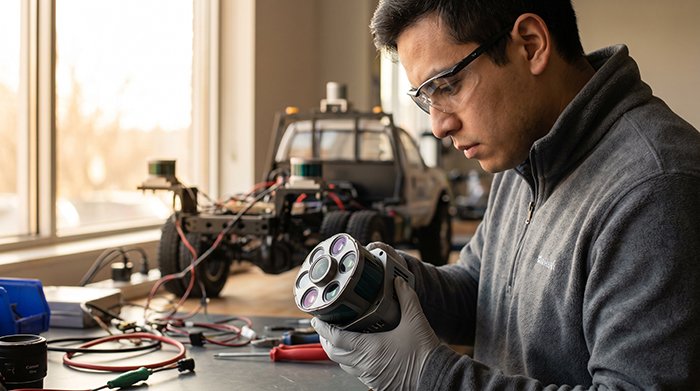
A fully loaded Class 8 truck cannot outrun physics — and at highway speed, physics demands more than 600 feet of warning before a stop is even possible.
According to the Federal Motor Carrier Safety Administration, a loaded Class 8 truck traveling at 65 mph requires up to 600 feet — approximately 183 meters — to stop under ideal conditions. That figure assumes dry pavement, well-maintained brakes, and a driver who reacts instantly. None of those conditions are guaranteed on a live highway.
Kinetic energy scales with the square of velocity, not linearly. An 80,000 lb vehicle at 65 mph carries an enormous momentum burden that air brake systems, with their inherent pressure-build lag, cannot dissolve quickly. That lag alone — typically 0.4 to 0.7 seconds before brakes fully engage — can consume another 60+ feet before deceleration meaningfully begins.
Human perception adds its own bottleneck. A driver averages 1.5 seconds of reaction time; an autonomous system may respond in milliseconds. But that computational advantage evaporates if the sensor horizon is too short. Long-range LiDAR autonomous trucks are specifically designed to close this gap — detecting obstacles at distances that give onboard systems enough time to execute a full, controlled stop rather than a desperate one.
Environmental factors compress the available window further. Rain and fog scatter laser pulses, degrading effective range on systems not engineered for adverse conditions. A sensor rated at 150 meters in clear air may perform closer to 80 meters in heavy rain — well inside the minimum stopping distance. Hardware built around 1550nm fiber laser technology offers better penetration through atmospheric interference, pushing the reliable detection envelope outward precisely when it matters most.
The safety gap — the distance between first detection and a complete stop — defines whether an autonomous truck survives an encounter or doesn’t. Understanding exactly how much distance each additional meter of range buys, in real seconds of decision time, is where the math gets compelling.
The 3.4-Second Benefit: Quantifying Perception Range
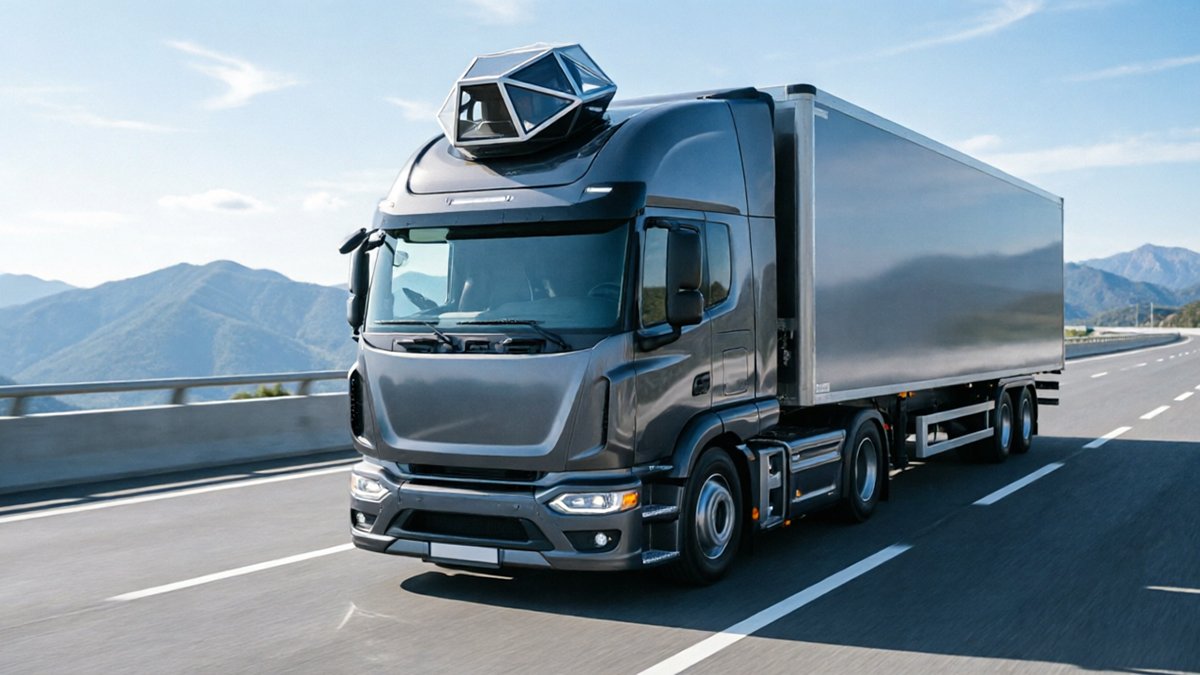
Every additional meter of detection range converts directly into compute time — and for a 40-ton truck, that time is the difference between a smooth stop and a catastrophic collision.
Gaining 100 meters of range doesn’t just improve safety — it buys the autonomous system 3.4 extra seconds to act. According to SAE International, increasing LiDAR detection range from 150 meters to 250 meters delivers exactly that: 3.4 extra seconds of reaction time at highway speeds. For context, a human driver averages just 1.5 seconds of reaction time in ideal conditions. That gap represents an enormous computational runway.
Here’s where those 3.4 seconds actually go inside the perception-to-decision pipeline:
- Detection (~0.2s): Raw point cloud data flags a potential object in the sensor’s field of view.
- Classification (~0.8–1.2s): The system distinguishes between a tire debris, a stopped vehicle, or a pedestrian — each requiring a different response profile.
- Confidence scoring (~0.4s): Multiple return scans build statistical certainty before committing to an action.
- Path planning (~0.6–1.0s): The autonomy stack calculates braking force, lane changes, or evasive maneuvers.
- Actuation (~0.5s): Mechanical systems execute the command.
Classification requires the most computational resources. At 150 meters, low point density forces the system to act on ambiguous data, increasing the risk of phantom braking — unnecessary hard stops triggered by misclassified objects. This erodes fleet operator trust and creates real rear-end collision hazards from following traffic.
At 250 meters, higher point density enables more confident spatial classification before the object enters the critical braking zone. The look-ahead distance finally matches the vehicle’s actual kinetic profile.
This is also where laser wavelength becomes impossible to ignore. Whether a sensor achieves that 250-meter threshold reliably — especially against dark or low-reflectivity targets — comes down to the core hardware choice, specifically the debate around 1550nm vs 905nm LiDAR for trucking applications.
Wavelength Wars: Why 1550nm is Essential for Long-Haul
The wavelength a LiDAR system uses isn’t a minor engineering detail — it’s the variable that determines whether a sensor can deliver meaningful LiDAR detection range safety on a dark interstate at 65 mph.
905nm systems hit a hard physical ceiling driven entirely by eye safety. The human retina absorbs 905nm light efficiently, which means regulators cap permissible power output at levels too low to generate reliable returns from objects beyond 150–180 meters. Pushing more photons at that wavelength isn’t an option; it becomes a hazard to anyone in the beam path.
1550nm fiber lasers operate in a spectral region where the cornea and lens absorb energy before it ever reaches the retina. That biological buffer allows engineers to run significantly higher output power while remaining within Class 1 eye-safe limits — a point worth understanding before the next section explores why even 300-meter range can feel inadequate at interstate speeds.
“Class 1 eye-safe laser products present no hazard under normal use conditions — 1550nm systems achieve this classification at power levels that would make 905nm units unsafe.” — Trucking Info, LiDAR Eye Safety Analysis
Higher permissible power translates directly into photon count at distance. According to research covered by Nature Photonics and Laser Focus World, 1550nm systems demonstrate measurably superior detection of low-reflectivity objects — think shredded truck tires, matte-black vehicles, or wet pavement debris — at distances exceeding 250 meters.
The advantages specific to long-haul operation include:
- Low-reflectivity detection: Consistent point clouds on dark objects that 905nm sensors routinely miss at range
- Higher SNR at distance: More photons per pulse means stronger return signals against ambient noise
- Eye-safe high power: Regulatory headroom to scale output without redesigning safety architecture
- Thermal stability: Fiber laser architectures distribute heat more evenly, supporting the continuous duty cycles freight routes demand
- Weather resilience: Longer wavelengths scatter less in light rain and fog compared to shorter alternatives
Thermal management deserves specific attention. High-power sensors running 24/7 across multi-day routes face reliability demands that laboratory prototypes never encounter — and that gap between R&D performance and road-ready durability is exactly where the next generation of hardware must prove itself.
Overcoming the High-Speed Perception Bottleneck
Perception range is the single greatest bottleneck standing between today’s autonomous trucking prototypes and scalable, safe highway deployment at speed.
Urban LiDAR configurations simply aren’t built for the interstate. Systems designed for city environments prioritize wide field-of-view and dense short-range mapping — optimized for pedestrians at 30 mph, not for a debris field at 65 mph. On the highway, those short-range sensors leave a dangerous gap: by the time an obstacle enters detection range, the autonomous truck braking distance required to stop safely has already exceeded what physics allows.
The necessity of a 300-meter clear view isn’t arbitrary. As noted by Autonomous Vehicle International, “perception range is the primary bottleneck for high-speed autonomous trucking; without a 300-meter clear view, the vehicle cannot safely operate at highway speeds.” A 40-ton rig traveling at 65 mph needs roughly 150–200 meters just to brake to a stop — and that assumes ideal road conditions. The 300-meter threshold builds in the margin that real-world variability demands.
Sensor fusion compounds the problem. When LiDAR range falls short of radar or camera depth, the data layers stop aligning cleanly. Radar might detect a slowing vehicle at 250 meters while LiDAR can only confirm it at 80 — a mismatch that forces the fusion algorithm to choose between incomplete data sets rather than synthesizing complementary ones. 3D forward-facing sensor architectures address this directly by extending LiDAR depth to match the range capabilities of radar, enabling true multi-modal agreement.
Hardware maturity is the final hurdle. R&D prototypes can achieve long-range performance in controlled conditions, but automotive-grade production systems must deliver that same reliability across millions of operating hours, temperature extremes, and vibration loads. The transition to automotive-grade long-range sensors built for continuous heavy-duty deployment represents the critical step from proof-of-concept to commercial reality — and it raises its own integration challenges worth examining closely.
Operationalizing Long-Range LiDAR: Integration Challenges
Deploying high-resolution LiDAR for freight operations is never plug-and-play — the physical realities of a Class 8 truck introduce engineering challenges that lab testing rarely anticipates.
- Mounting height and placement. Cab-top mounting remains the preferred position for maximizing horizon coverage, typically elevating the sensor 13–14 feet above road level. This height advantage extends the effective detection cone toward the 300-meter threshold that highway safety demands. Side-mirror placements serve as useful supplementary positions for lateral coverage but sacrifice forward range due to the narrower sight line past the trailer body.
- Vibration damping. A 128-channel spinning array is a precision optical instrument operating inside a machine that generates constant broadband vibration. Without purpose-engineered isolation mounts — typically elastomeric dampers rated to automotive standards — micro-vibrations corrupt point cloud geometry and introduce scan-line artifacts. Even small angular disturbances at the sensor head translate to significant positional errors at 200 meters.
- Data throughput demands. High-density point clouds don’t travel light. Systems generating millions of points per second require robust automotive-grade Ethernet backbones to move data from sensor to compute stack without bottlenecking the perception pipeline. Undersized network architecture is one of the most common integration oversights on early-stage truck builds.
- Cleaning and maintenance. Long-haul routes expose sensor apertures to road grime, diesel particulate, insect debris, and seasonal road salt. In practice, even a thin film of contamination measurably degrades return signal strength at distance. Pressurized washer systems — similar to camera lens cleaners already used in production vehicles — are increasingly standard on freight-grade sensor housings.
Getting these four variables right is the foundation of a reliable sensing stack. But engineering excellence only matters if procurement delivers the right hardware at scale — which raises a distinct set of economic questions.
The Economics of Procurement: Direct-to-Factory Models
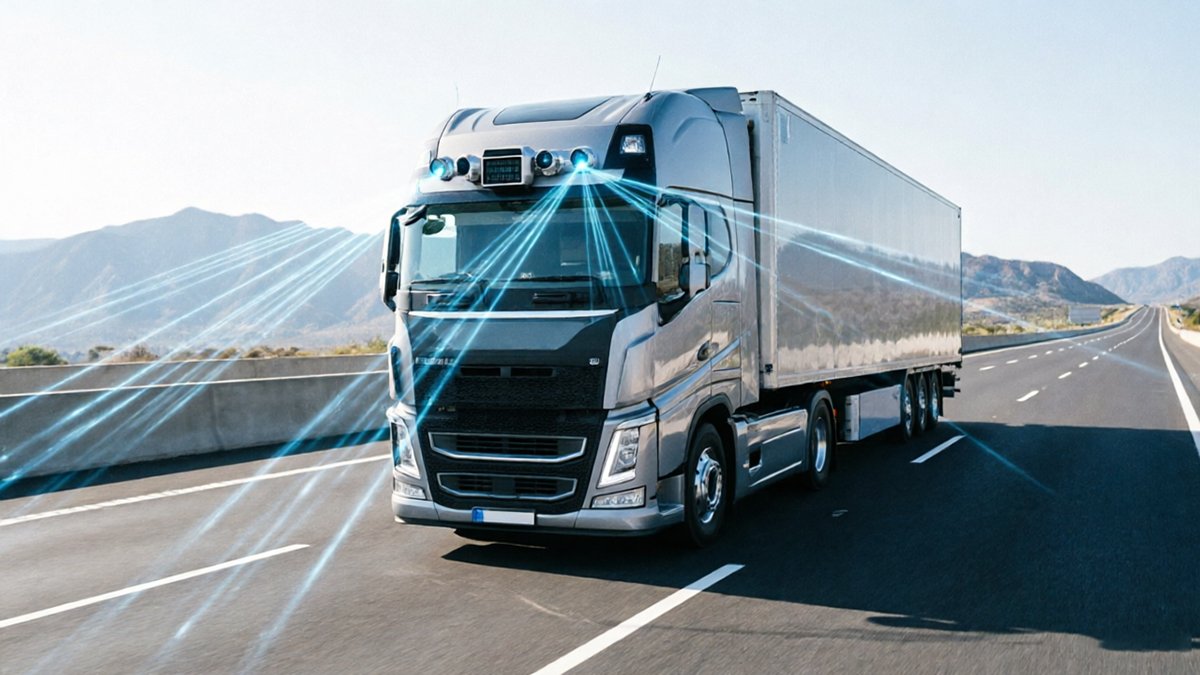
Scaling autonomous heavy trucking from pilot programs to full fleet deployment hinges as much on procurement strategy as it does on sensor performance.
The shift from experimental sourcing to volume buying changes everything. Early-stage AV programs typically sourced LiDAR through resellers, system integrators, or one-off distributor agreements — workable for a handful of test rigs, but economically unsustainable at fleet scale. When a single deployment can require dozens of sensors per vehicle across hundreds of trucks, intermediary markups compound rapidly into a serious budget liability.
Factory-direct pricing addresses this problem head-on. For LiDAR sensor procurement for robotics and commercial autonomy programs, cutting out the middleman isn’t just a cost-saving tactic — it’s a structural necessity. LidarStar provides direct factory pricing on automotive-grade LiDAR sensors, eliminating intermediaries for global R&D teams. That model translates to measurable savings at volume while maintaining access to the same hardware quality that OEM-tier programs demand.
Certification compliance adds another layer of complexity to sourcing. Fleet operators and Tier-1 integrators need hardware that arrives triple-certified — IEC, CE, and RoHS compliance are baseline expectations for any sensor destined for a commercial vehicle operating on public roads. Working with a distributor that verifies these certifications upstream, rather than placing the burden on the buyer’s engineering team, compresses procurement timelines considerably.
Sensor selection itself requires deliberate navigation. The LiDAR market spans a wide range of configurations — 2D vs. 3D, 16-channel to 128-channel, mechanical to hybrid solid-state architectures — each with distinct trade-offs in range, resolution, and cost. Buyers sourcing for long-range forward perception on Class 8 platforms need clear specification guidance to avoid mismatched hardware.
Getting procurement right today positions fleets to adopt the next generation of sensor hardware as the technology and regulatory landscape continues to evolve.
Future-Proofing the Autonomous Fleet
Regulatory momentum, materials science, and supply-chain economics are converging to make 300m+ LiDAR not just best practice — but the mandatory baseline for every autonomous heavy truck on US highways.
Anticipating FMCSA frameworks is the first strategic priority. As California’s clearance of heavy-duty autonomous truck pilots accelerates federal attention, FMCSA rulemaking around autonomous emergency braking thresholds is widely expected to codify minimum detection distances tied to Class 8 stopping physics. Fleets that spec 300m sensors today won’t need a costly hardware refresh when those rules arrive.
Three trends are shaping what “future-proof” actually looks like in practice:
- Solid-state sensor adoption. Mechanical spinning units are giving way to solid-state architectures with no moving parts — delivering longer service intervals and significantly higher vibration tolerance, which matters enormously on long-haul freight routes with variable road surfaces.
- Extended operational speed windows in adverse weather. A 300m+ detection envelope doesn’t just protect against clear-day hazards. It provides reliable perception in rain, fog, and low-light conditions where camera-based systems degrade sharply, enabling higher permissible operational speeds without compressing the reaction buffer below safe thresholds.
- Hardware cost compression meets high-performance specs. As noted in the previous section on direct-to-factory procurement, LiDAR’s role in autonomous trucking is expanding precisely because high-spec units are becoming economically accessible at fleet scale — not just for pilot programs.
Triple-certified hardware — meeting multiple international autonomous deployment safety standards simultaneously — is increasingly the procurement benchmark, ensuring sensors cleared today remain compliant as global frameworks tighten.
What these trends ultimately demand is a clear, consolidated checklist of the non-negotiables — the specific thresholds and specifications every trucking engineer should carry into every sensor evaluation.
The Bottom Line: Key Takeaways for Trucking Engineers
Autonomous heavy trucking has exactly one safety floor that matters: the ability to detect, classify, and stop for obstacles before physics makes the decision for you.
Every section of this article has built toward a single, actionable conclusion. Here’s what trucking engineers and fleet decision-makers need to internalize before specifying or procuring a LiDAR stack:
- 600 feet is the hard minimum. At 65 mph, a fully loaded Class 8 truck requires approximately 600 feet to stop. That isn’t a guideline — it’s a physics-backed constraint that every sensor specification must honor from day one. Any system with a shorter detection range is operating inside its own stopping distance.
- 1550nm is the performance standard for dark-object detection. At ranges beyond 250 meters, 905nm vs. 1550nm wavelength choice becomes the difference between detecting a tire tread on dark pavement and missing it entirely. Eye-safe 1550nm systems consistently outperform at distance in low-reflectivity conditions — the exact scenarios where accidents happen.
- A 250m detection range buys 3.4 seconds of reaction time over sensors that top out at 150m. That buffer is not a comfort margin — it’s the operational window for perception processing, decision logic, and mechanical braking to function in sequence.
- Factory-direct procurement is the only scalable economic model. As covered earlier, per-unit costs drop dramatically when hardware is sourced without distributor markups. LidarStar offers a broad catalog of 2D and 3D sensors backed by 24-hour technical support for global engineering teams — the kind of infrastructure that makes fleet-scale deployment realistic.
The mandate is clear: 300 meters of reliable detection range is not a premium feature — it’s the minimum viable specification for any autonomous heavy truck operating on public roads.
Still have technical questions about wavelength trade-offs, weather performance, or power requirements? The next section addresses the most common engineering queries directly.
Long-Range LiDAR FAQ & Technical Resources
The right LiDAR specification can mean the difference between a safe stop and a catastrophic collision — and these four questions come up most often among trucking engineers evaluating long-range systems.
Q: What is the difference between 905nm and 1550nm wavelengths for trucking?
905nm sensors are lower-cost and widely deployed, but 1550nm systems offer superior eye safety at higher power outputs, enabling stronger return signals at distance. For 300m+ detection requirements, 1550nm architectures can push more optical energy safely, producing better point-cloud density on dark or low-reflectivity targets like unlighted trailers.
Q: How does weather affect long-range LiDAR performance?
Rain, fog, and dust scatter laser pulses before they reach full range. In practice, a system rated for 300m in clear conditions may drop to 150–200m in heavy rain. Engineers account for this through sensor redundancy and dynamic perception thresholds — the system raises alert status when degraded conditions reduce the safety margin below the braking distance floor. As LiDAR News notes, layered sensor strategies directly address this limitation.
Q: Can 2D LiDAR be used for autonomous truck navigation?
2D LiDAR captures a single horizontal plane, making it fundamentally inadequate for highway autonomy. It cannot resolve object height, classify vehicles, or detect debris below or above its scan plane. High-channel 3D systems are the baseline requirement.
Q: What are the power requirements for high-channel 3D LiDAR?
Solid-state and spinning 3D units in the 128-channel range typically draw between 8W and 30W depending on pulse rate and cooling design — well within a modern truck’s 12V/24V auxiliary supply, though thermal management remains a key integration consideration.
📺 For a side-by-side technical comparison of LiDAR sensor architectures in trucking applications, see the LiDAR technology overview from LidarStar.
The safety case for autonomous heavy trucking ultimately rests on one engineering commitment: deploy sensors that outpace physics. Long-range LiDAR is that commitment made hardware.