
Unplanned downtime in industrial automation costs manufacturers an average of $260,000 per hour — and non-rated sensors contribute significantly.
Industrial environments don’t resemble a lab. Defining “harsh” means accounting for airborne particulates from grinding and cutting, humidity that spikes and crashes with shift changes, and aggressive chemical washdowns that occur multiple times per day. Standard sensors often treat these as edge cases. Industrial floors treat them as routine.
Failure modes of non-rated sensors in these conditions are well-documented and expensive:
- Internal fogging — moisture infiltrates housing seals, condensing on optics and degrading range accuracy
- Optical interference — particulate contamination scatters light pulses, producing phantom returns and missed detections
- Corrosion of internal electronics — chemical aerosols accelerate conductor degradation, leading to intermittent failures that are notoriously difficult to diagnose
Consumer-grade solutions, such as compact LiDAR units found in mobile devices or hobbyist robotics, are designed for controlled, intermittent use. They simply aren’t engineered for 24/7 industrial uptime under thermal cycling, vibration, and chemical exposure. Deploying them on a production line isn’t cost-effective engineering; it leads to deferred failure.
Sensor reliability is a system safety issue, not just a maintenance one. When a sensor on an automated guided vehicle or a collaborative robot arm produces unreliable data, the downstream consequences include collision risk, production stoppages, and regulatory exposure. For applications where sensors must perform across demanding factory automation scenarios, the hardware standard isn’t optional — it’s foundational.
This is precisely where IP67 industrial LiDAR separates itself from alternatives. According to the IEC Standard 60529, IP67 certification guarantees total protection against dust ingress and sustained immersion in water up to 1 meter for 30 minutes. Understanding what that rating actually means — and why every digit matters — requires a closer look at the standard itself.
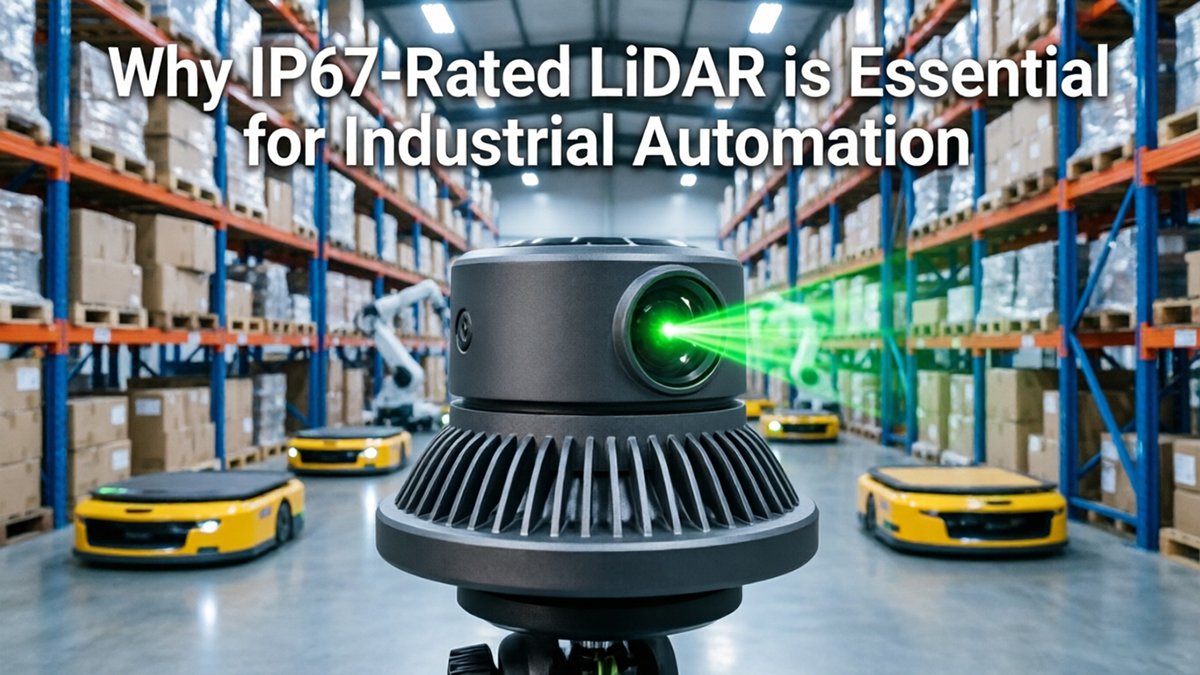
Decoding the IP67 Standard for Industrial Hardware
Harsh environment LiDAR sensors are only as reliable as the protection standard behind them — and IP67 is where theoretical durability meets engineering reality.
The “IP” in IP67 stands for Ingress Protection, defined by IEC standard 60529. Each digit targets a distinct threat category:
- The “6” digit (dust): A rating of 6 represents complete, total dust-tightness — no particulate ingress whatsoever, even under vacuum-level pressure differentials. For rotating or scanning sensor assemblies, this matters enormously. Dust accumulation inside a motor housing accelerates bearing wear, increases heat, and degrades encoder accuracy over time. Zero ingress tolerance is the only acceptable standard on a production floor.
- The “7” digit (water): This certifies temporary immersion in up to 1 meter of water for 30 minutes. More practically for manufacturing, it means the sensor’s sealing survives high-pressure wash-down cycles — the kind used in food processing, pharmaceutical, and chemical facilities on a daily basis.
Sealing architecture differs significantly between sensor types. 2D LiDAR sensors used in navigation typically rely on solid-state designs with no moving parts, making hermetic sealing more straightforward. 3D mechanical sensors, by contrast, require rotating assemblies with dynamic seals — a considerably harder engineering challenge that not every manufacturer solves equally well.
“The shift toward Industry 4.0 requires sensors that can withstand ‘wash-down’ procedures without compromising data integrity.” — Association for Advancing Automation (A3)
Triple certification matters in global deployments. Facilities operating across the US, EU, and Asian markets need sensors validated against IEC, UL, and CE frameworks simultaneously. A single-jurisdiction rating creates compliance gaps that procurement teams routinely overlook — until an audit flags them.
Protection ratings, however, only address the physical enclosure. What happens when the air itself becomes the contamination source — filled with sawdust, steam, or chemical vapor? That’s where hardware sealing alone falls short.
Multi-Echo Technology: Seeing Through the Fog
Rugged LiDAR for industrial automation must do more than survive moisture and debris — it must maintain accurate readings through the airborne particulates that dense industrial environments constantly generate.
The physics challenge is straightforward: when a laser pulse travels through dust-laden air or steam, it doesn’t reach a single surface cleanly. Instead, it strikes multiple targets simultaneously — a cloud of sawdust at 1.2 meters, then the actual machine surface at 3.8 meters. A conventional single-echo sensor records only the first return signal, meaning it “sees” the particulate cloud instead of the real obstacle.
Multi-echo evaluation solves this by analyzing the full return sequence from a single pulse:
- First echo — captures the nearest reflection, often an airborne particle
- Intermediate echoes — reveal layered obstructions or semi-transparent surfaces
- Last echo — identifies the solid background surface the beam ultimately reached
By processing all return pulses together, the sensor’s onboard firmware distinguishes genuine physical targets from environmental noise. According to the PWC Industrial Automation Report, multi-echo technology can filter out up to 95% of noise caused by dust, steam, or heavy rain — a critical threshold in woodworking mills or chemical processing plants where airborne contamination is essentially constant.
IP67 housing alone cannot address this challenge. A perfectly sealed enclosure keeps water and dust out of the sensor’s internal components, but it cannot stop airborne particles from distorting outbound laser pulses. Without intelligent signal filtering, even the most hardened sensor will generate false positives or miss real targets in dirty air. Hardware protection and software intelligence are co-dependent — neither is sufficient on its own.
This processing capability becomes especially critical in facilities where automated vehicles navigate confined, contaminated spaces — which sets up an important question for high-hygiene environments like washdown zones.
Optimizing AGV Navigation in Washdown Zones
IP67-rated LiDAR is the baseline requirement for any AGV operating in food processing or pharmaceutical environments — where hygiene protocols, temperature swings, and chemical exposure create conditions that defeat standard sensors within weeks.
Navigation challenges in high-hygiene zones
Standard 2D LiDAR units struggle in washdown environments because their mechanical components and unsealed housings absorb moisture during high-pressure cleaning cycles. Water ingress corrupts scan data, introduces ghost returns, and — critically — the principles of how to choose LiDAR for dusty environments apply equally here: the same particulate-rejection logic that filters airborne debris also governs performance around steam and cleaning aerosols. According to the Association for Advancing Automation (A3), IP67-rated LiDAR is essential in food processing because it withstands moisture and aggressive cleaning agents used in high-hygiene facilities.
*Internal fogging during cold-storage transitions
Cold storage corridors create a compounding threat. When an AGV moves from a refrigerated zone into a warmer staging area, rapid temperature differentials cause condensation to form on internal optical surfaces — effectively blinding the sensor mid-transit. Sealed, IP67-rated units with thermally stabilized housings prevent this internal fogging, maintaining scan integrity across the full route. For operations requiring long-range awareness in these transitions, 360° coverage sensors eliminate the multi-sensor configurations that multiply failure points.
Reliability in tight, wet industrial corridors
Blind-spot compensation sensors mounted at low angles help AGVs detect obstacles in narrow, wet corridors where steam obscures sightlines. In practice, facilities that upgraded to IP67-rated LiDAR report measurable reductions in AGV collisions near steam-injection stations — outcomes driven by consistent scan reliability rather than operator intervention.
The operational upside is clear. What’s less obvious — until something fails — is the full financial cost of deploying under-rated hardware in these environments.
The ROI of Ruggedization: Reducing Maintenance Downtime
Choosing IP67-rated sensors over cheaper, non-rated alternatives isn’t just a technical decision — it’s a financial one with measurable consequences across every shift.
A single sensor failure on a production line can halt operations for hours, triggering cascading costs: idle labor, missed throughput targets, emergency procurement, and technician callouts. In high-volume facilities, unplanned downtime frequently runs into thousands of dollars per hour. That context makes the price premium on ruggedized hardware look far more reasonable.
Non-rated sensors face a particular threat from fine particulates. Dust and debris infiltrate mechanical motor housings through microscopic gaps, degrading bearings and rotating assemblies over months of continuous operation. What begins as occasional calibration drift can escalate into full sensor failure — with little warning. Solid-state designs eliminate this vulnerability entirely by removing the spinning mechanism, making them significantly more resilient in dusty or debris-heavy environments.
The hidden costs compound further in warehouses where lens contamination requires manual cleaning cycles. Technicians pulled from productive tasks, scheduled maintenance windows, and the risk of lens scratching during repeated cleaning all add up quietly. These friction points rarely appear in an initial sensor budget — but they’re real operational drains.
Key cost-saving advantages of IP67-rated ruggedized LiDAR include:
- Reduced unplanned downtime — sealed housings prevent the particulate ingress that causes sudden failures
- Lower maintenance labor costs — minimal lens cleaning and fewer calibration interventions
- Extended sensor lifespan — solid-state units outlast mechanical alternatives in abrasive environments
- Fewer emergency replacements — particularly relevant for IP67 2D LiDAR for AGV navigation in washdown areas, where exposure is constant
According to a Logistics Management warehouse automation study, solid-state and high-protection mechanical LiDARs reduce maintenance downtime by 40% compared to non-rated sensors in harsh environments — a figure that compounds significantly over a multi-year deployment. Understanding these numbers is the first step; selecting the right sensor type for your specific environment is the next, and that requires matching specifications carefully to operating conditions.
Technical Selection Guide: Choosing the Right Rugged Sensor
Datasheets tell only part of the story — selecting the right IP67-rated LiDAR for a harsh industrial environment requires evaluating several interdependent factors that spec sheets rarely surface.
The sensor type you choose should directly reflect your environment’s particulate density. In moderate-dust scenarios like automotive assembly, 2D LiDAR remains a highly capable choice for perimeter scanning and AGV guidance. In high-density particulate environments — grain processing, cement plants, or heavy chemical facilities — 3D LiDAR with multi-echo capability is the more reliable option, since it resolves ambiguous returns caused by suspended particles more effectively than single-echo 2D systems.
Use this checklist when evaluating any rugged sensor:
| Environment Condition | Required Sensor Feature |
|---|---|
| High particulate density | Multi-echo 3D LiDAR + IP67 housing |
| Frequent washdowns | Sealed connector (M12 or equivalent) |
| Wide temperature swings | Aluminum housing over plastic |
| Outdoor or UV-exposed | UV-stabilized enclosure material |
| Limited downtime tolerance | Factory-direct technical support |
Housing material matters more than most engineers expect. Aluminum housings dissipate heat more effectively and resist long-term deformation from thermal cycling, while plastic housings — even reinforced grades — can develop micro-cracks over time. Similarly, connector seals rated to the same IP level as the housing are non-negotiable; a single non-rated M8 connector undermines the entire enclosure rating.
“By preventing fine particulates from entering the motor housing, IP67 sensors eliminate the need for frequent manual cleaning.” — Logistics Management
Factory-direct technical support becomes critical during complex deployments where integration challenges arise mid-project. Equally important is procurement speed — for R&D teams working against tight timelines, a supplier with global logistics infrastructure can mean the difference between a delayed prototype and an on-schedule milestone.
Once the right sensor is selected and installed, understanding how to interpret its output data is the next critical step — which is exactly where visualizing LiDAR performance in real industrial conditions becomes essential.
Visualizing Industrial LiDAR Performance
Seeing how IP67-rated LiDAR behaves under real-world stress conditions is one of the fastest ways to justify the specification to engineering and procurement teams alike.
Point cloud clarity is the ultimate performance benchmark — and nowhere is this more apparent than in high-dust scenarios. According to Sensor Technology Review, advanced IP67 sensors allow the laser pulse to penetrate through airborne particles to hit the intended solid target, rather than scattering returns across the cloud. The practical result is a cleaner, more reliable 3D map even when visibility is severely compromised.
The video below captures this difference in action, demonstrating side-by-side point cloud outputs, IP67 vs. IP65 sensor behavior in particulate-heavy air, and a walkthrough of multi-echo stream interpretation.
[YouTube Video Placeholder]
Three key takeaways from the demonstration:
- Point cloud density under dust load: IP67-rated units maintain consistent return density, while lower-rated sensors show increasing void regions as particulate ingress degrades internal optics over time.
- IP67 vs. IP65 visual comparison: The performance gap widens incrementally — IP65 holds up in light splash conditions but falters when fine dust accumulates inside the housing, corrupting baseline calibration.
- Reading multi-echo data streams: Each laser pulse can generate multiple return signals. The first echo typically captures airborne particles; subsequent echoes hit solid surfaces. Filtering to the last or strongest echo isolates the true target geometry — a technique that’s critical for autonomous navigation in GPS-denied spaces like warehouse floors and processing facilities.
Understanding these visual outputs helps teams evaluate sensor specifications beyond the datasheet — and sets the stage for the consolidated takeaways every industrial deployment team needs before making a final procurement decision.
The Bottom Line: Key Takeaways for Industrial Teams
IP67-rated LiDAR isn’t a premium upgrade — it’s the minimum viable specification for any industrial deployment where moisture, dust, or particulate contamination is present. As the previous sections have shown, sensor selection and environmental resilience directly shape system reliability, maintenance cycles, and total cost of ownership.
Here are the four core principles every engineering and procurement team should carry forward:
- IP67 is the floor, not the ceiling. Any environment involving water ingress risk or fine dust — whether a food processing line, an outdoor logistics yard, or a mining conveyor — demands IP67 as the baseline. Anything less introduces failure points that compound over time.
- Multi-echo processing is non-negotiable for 3D mapping accuracy. In environments with airborne particulates, rain, or fog, single-return sensors produce noisy, unreliable point clouds. Multi-echo evaluation filters false returns and preserves scan integrity where it matters most.
- Ruggedized sensors measurably reduce operational costs. According to Logistics Management, IP67-rated sensors eliminate the need for frequent manual cleaning and internal repairs — contributing to a roughly 40% reduction in maintenance-related downtime across industrial deployments.
- Procurement strategy shapes long-term R&D economics. Direct-to-factory sourcing models cut out intermediaries, compress lead times, and lower per-unit costs — freeing budget for system integration and iteration. Platforms offering direct access to industrial-grade sensors are increasingly relevant for teams scaling automation in cost-sensitive environments.
In practice, the strongest deployments treat sensor ruggedization and procurement efficiency as parallel priorities, not sequential ones. Getting both right from the start prevents the costly rework that comes from under-specifying hardware. If you still have questions about specific IP ratings, environmental performance thresholds, or mounting considerations, the next section addresses the most common technical queries that industrial teams raise before committing to a specification.
Frequently Asked Questions: Industrial IP67 LiDAR
Choosing the right IP-rated LiDAR sensor requires understanding how protection standards translate to real performance under rain, dust, pressure, and physical installation constraints.
Can IP67 sensors operate in heavy rain?
Yes. IP67-rated LiDAR handles direwater immersion up to one meter for 30 minutes, making rain exposure a manageable condition rather than a failure risk. In practice, sensors paired with multi-echo processing separate return signals from raindrops versus solid targets, maintaining reliable detection even in heavy downpour. This signal-discrimination capability is especially valuable in outdoor automation and mobile platform deployments where weather conditions are unpredictable.
What is the difference between IP67 and IP69K?
IP67 protects against temporary immersion; IP69K adds resistance to high-pressure, high-temperature steam cleaning — a standard required in food processing and pharmaceutical facilities. If your environment involves pressure washdowns, IP67 alone is insufficient. However, for most industrial automation scenarios involving rain, coolant mist, or washdown splash, IP67 provides adequate protection per IEC Standard 60529, which also confirms that proper sealing prevents the internal fogging that degrades lower-rated optics.
Do IP67 sensors require specialized mounting?
Not specialized hardware, but seal integrity at every cable entry point is non-negotiable. Improper gland fittings or compressed O-rings at the connector port will void the IP67 rating regardless of the sensor’s own certification. Standard industrial mounting brackets work, provided all conduit entries maintain the same ingress protection rating.
How does dust affect laser range?
Airborne particulates attenuate the laser pulse, reducing effective range. Multi-echo filtering distinguishes dust scatter from hard surface returns, partially recovering detection distance. For applications in cement plants or grain handling, where particulate density is extreme, pairing IP67 hardware with adaptive scanning techniques further compensates for signal loss.