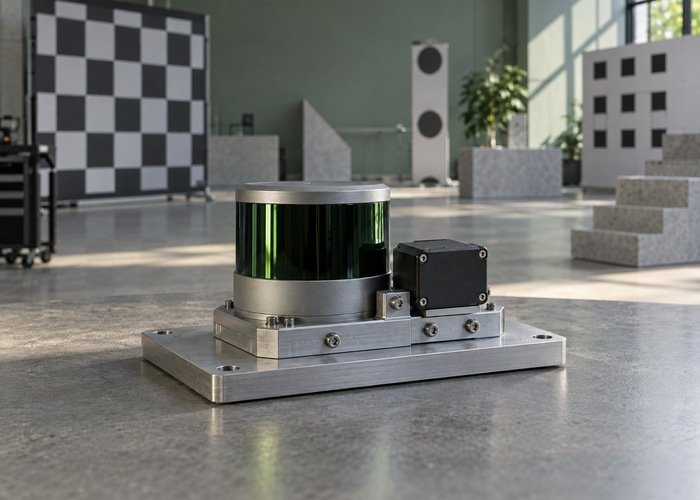
LiDAR–IMU calibration motion is sufficient when the initializer receives usable, varied motion and its result survives an independent repeat test. A long recording, a completed solver, or a sharp-looking map alone cannot establish that. The practical question is whether the capture constrained the quantities you need, with trustworthy timing and a rigid sensor relationship.
Use the initializer’s excitation feedback to guide the capture, preserve the output and configuration, and validate on motion excluded from the estimation run. If a required direction remains weak, repeat that part of the capture rather than collecting more of the same movement. Set application-specific acceptance criteria before comparing results.
This guide focuses on data sufficiency and the decision to recollect. The wider LiDAR, camera, and IMU calibration workflow covers mechanical preparation and frame relationships. Those prerequisites still apply, but the worksheet here is designed to expose a capture that looks busy while conveying too little information.
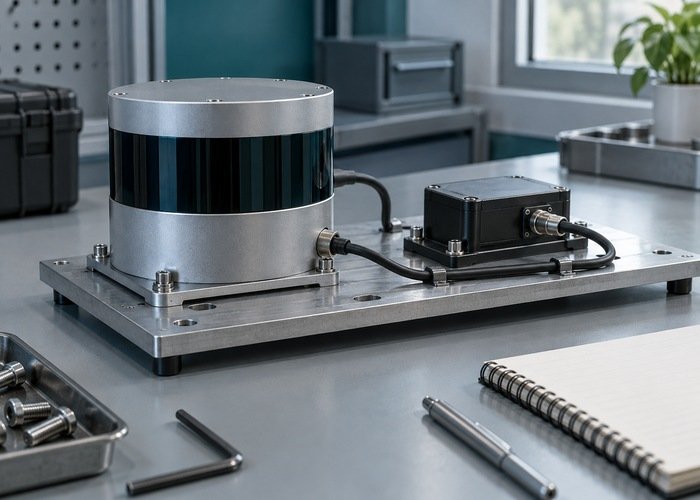
Separate usable input from useful motion
Check the message contract before moving the rig. Confirm the sensor models, firmware, driver revisions, topics, frames, clock sources, sampling behavior, and point-time convention. A capture cannot become informative if one stream is missing, misinterpreted, or consistently outside the other’s time coverage.
The ROS 2 Imu definition specifies angular velocity in radians per second and acceleration in metres per second squared. Inspect the emitting driver rather than inferring compliance from the topic name. Covariance fields also have defined semantics; an unavailable estimate must not be treated as a measured, perfectly certain quantity.
Preserve per-point timing and original message types using a recording plan such as the LiDAR–IMU data-preservation checklist. Keep a brief input-quality log: gaps, resets, rejected messages, clock jumps, and missing fields. If these appear, solve the input problem before deciding that the operator’s movement was insufficient.
Ask the initializer what remains unconstrained
The LiDAR_IMU_Init project recommends recording while running its initialization process so the operator can receive excitation feedback. Its instructions distinguish movement or rotation along requested directions. Treat that feedback as specific to the installed implementation, and retain the exact messages with the corresponding recording segment.
A planar mobile base may naturally provide repeated yaw turns and little roll or pitch variation. Adding more laps can increase recording length without adding the missing motion diversity. Conversely, a portable sensor fixture may allow other orientations, provided it is supported, its cables remain secure, and the movement follows an appropriate test procedure.
Do not force a heavy platform into unsafe tilts to satisfy a calibration tool. If the installed hardware cannot provide a requested motion, document the limitation and choose a suitable calibration method or fixture. Sensor selection and platform geometry belong in the earlier 2D-versus-3D robot sensor decision; neither choice automatically supplies informative inertial motion.
Build a capture worksheet around missing information
| Capture segment | Evidence to retain | Decision it supports |
|---|---|---|
| Initial stationary interval | Input stability and initializer startup messages | Proceed when the method’s startup requirements are met |
| Varied permitted rotations | Axis-specific feedback and corresponding time intervals | Repeat an unexcited direction where the rig permits it |
| Varied permitted translations | Motion log, scene continuity, and feedback | Avoid adding only copies of one movement |
| Completed initialization | Transforms, offset, biases, conventions, and logs | Freeze a candidate result for independent validation |
| Held-out repeat run | Previously unused motion and predefined observations | Accept, investigate, or collect a fresh estimation run |
The research paper behind LI-Init discusses identifying sufficient excitation for its initialization approach. It estimates several related quantities, including extrinsics and temporal offset. That is the reason to inspect the method’s feedback rather than apply a universal recording-duration rule to every sensor combination.
Use a scene with rigid surfaces and varied geometric structure, and retain sensor visibility during movement. Avoid a capture dominated by moving people or objects. Note where the sensor loses useful geometry, where the mount may flex, and where a cable constrains movement. These observations help explain a failed segment without inventing a numerical quality score.
Read configuration examples as examples
A repository’s sensor-specific configuration file is useful for locating relevant parameters, but its values are not a template for unrelated hardware. Compare your input topics, preprocessing selections, sampling assumptions, and initialization settings with your actual driver and rig. Save the effective configuration, not merely the file you intended to launch.
Follow the installed method’s startup sequence, including any initial stationary phase it requests. Preserve the first successful output before trying alternatives. If you change the sensor mount or a timing conversion between runs, label that as a different experiment; otherwise the comparison mixes capture sufficiency with an input-contract change.
Simulation can help rehearse capture and inspection steps, but it does not prove that physical timestamps, mounting rigidity, or sensor noise match the model. The LiDAR simulation guide explains that boundary. Use simulated runs to prepare the procedure and physical runs to validate the installed relationship.
Freeze the candidate and test unused motion
Record the estimated rotation, translation, temporal offset, and any other output required by the consumer. Include frame direction, units, and timestamp convention. A transform from IMU to LiDAR is not interchangeable with its inverse, and a time-offset sign can reverse when the configuration describes the opposite relationship.
Before transferring the result into FAST-LIO, consult the consumer’s current documentation and the source of your installed revision. Confirm that the expected frames and timing inputs match. Do not assume a successful initialization package and a downstream port share every parameter name or convention.
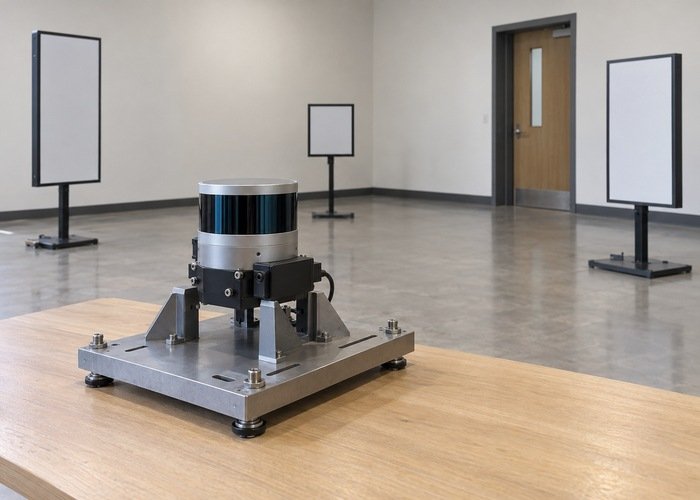
Keep the candidate fixed during held-out validation. Use a different capture containing permitted movements and stable reference geometry that were not used to estimate it. Inspect static and moving behavior separately. Record whether edge separation or map inconsistency correlates with turning, translation, viewing direction, or a particular part of the scene.
Repeat validation without selecting only the most attractive screenshot. For an application such as pallet handling, define which geometric checks support the task using a robot integration test plan. Agree tolerances from the application and reference method; this article supplies no universal accuracy threshold.
Recollect, investigate inputs, or accept with evidence
Recollect when the initializer continues to request missing motion and the rig can safely provide it. Repeating the same trajectory is unlikely to resolve a missing direction. Save the failed capture as evidence, then make a specific change to the next acquisition plan.
Investigate inputs when timing coverage, units, axes, or mounting stability remain uncertain. A low residual cannot repair an incorrect data contract. If repeated independent estimation runs produce materially different outputs, compare conventions and input quality before averaging the results; averaging can hide incompatible estimates.
Accept a candidate only when its input checks, method-specific sufficiency feedback, and held-out observations support the predefined application criteria. Retain the raw captures, solver revision, effective configuration, output conventions, validation observations, and mount photographs. This makes future recalibration after service or software changes reproducible.
Frequently asked questions
Does a longer recording guarantee sufficient excitation?
No. Duration adds samples, but repeated movement can leave the same quantities weakly constrained. Use directional feedback and independent validation to decide what the next capture needs.
Is a stationary start the whole calibration?
No. It can satisfy a method’s startup requirement, while later informative motion is still needed. Follow the installed algorithm’s sequence and preserve its feedback.
Can I validate on the recording used to estimate the result?
That checks internal consistency, but it is weaker than a separate run. Keep an unused capture to challenge the frozen result under different permitted motion.
Should I collect aggressive movements when initialization fails?
Choose controlled motion supported by the rig and test procedure. First inspect the missing direction and input quality. More violent movement is not evidence of better calibration data.