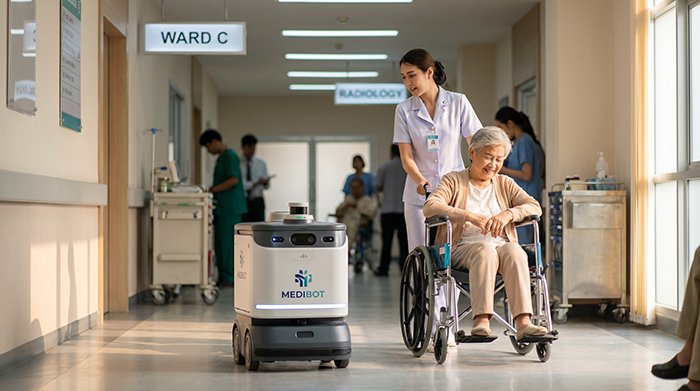
Hospital corridors are among the most unforgiving navigation environments on earth — and most robotic systems aren’t built for them.
A warehouse floor follows predictable patterns. A sidewalk, while variable, moves slowly. But a hospital corridor operates on an entirely different level of complexity. Nurses pivot mid-stride, supply carts appear from alcoves, and patients in wheelchairs navigate unpredictably — all within centimeters of a moving robot. According to research published in the International Journal of Advanced Robotic Systemsobotic Systems](https://pmc.ncbi.nlm.nih.gov/articles/PMC12902103/), hospitals qualify as “highly dynamic” environments where obstacles can move at speeds up to 1.5 meters per second according to the study. That’s fast enough to overwhelm any navigation system with a meaningful processing lag.
Camera-only navigation compounds the problem. Sterile hospital corridors are deliberately designed to be visually uniform — consistent wall colors, minimal signage clutter, standardized lighting. That uniformity, while critical for infection control, strips away the visual landmarks that camera-based systems depend on for localization. When every hallway looks identical, visual odometry drifts, and position estimates degrade quickly. The result is a robot that loses confidence in where it actually is.
The stakes of getting this wrong aren’t measured in productivity metrics — they’re measured in patient outcomes. A collision with an IV pole doesn’t just cause property damage; it can contaminate a sterile field, disrupt a medication delivery, or injure a vulnerable patient. Standard industrial autonomous mobile robots (AMRs), engineered for the controlled chaos of a fulfillment center, simply weren’t designed for these constraints. They lack the sensor redundancy and real-time obstacle resolution that emergency and critical care environments demand.
Effective delivery robot LiDAR navigation isn’t optional in these settings — it’s the foundational requirement. And as the next section explores, even LiDAR itself has a critical limitation that separates adequate solutions from genuinely safe ones: what the sensor sees below knee height.
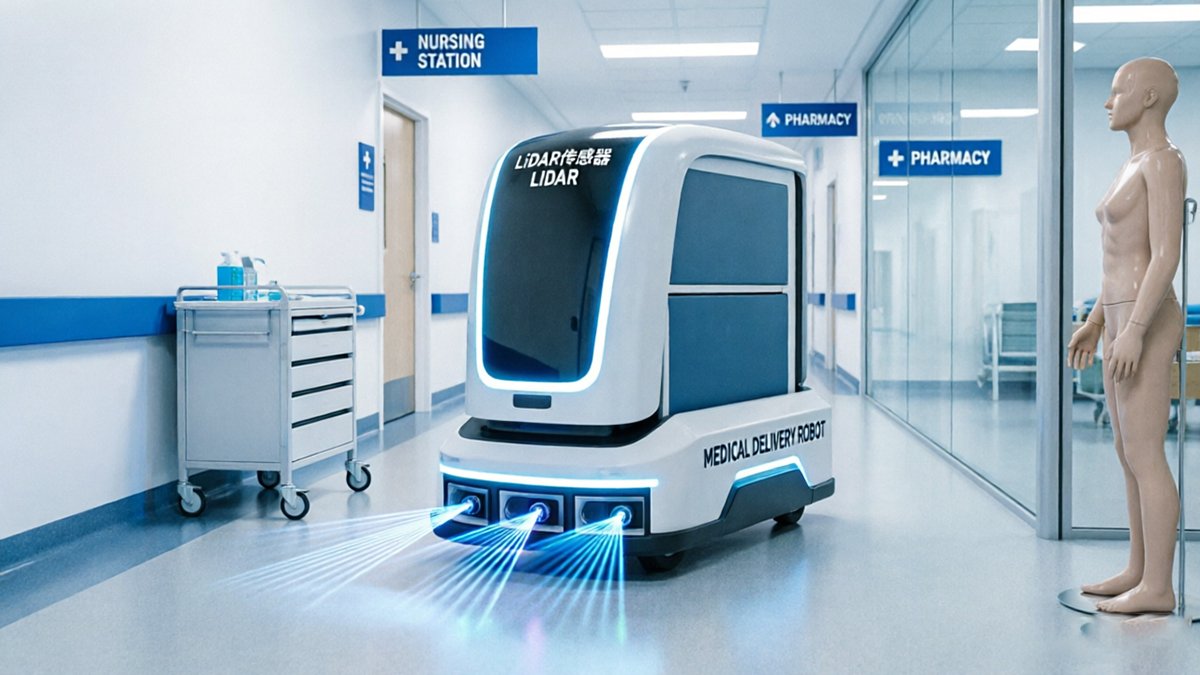
Beyond the Floor: Detecting Low-Profile Obstacles with 3D LiDAR
Choosing the right autonomous medical delivery robot sensors isn’t just about range or speed — it’s about whether the system can see the full three-dimensional reality of a hospital corridor.
2D LiDAR scans a single horizontal plane, typically set at the robot’s mid-height. In an open warehouse or retail floor, that’s often sufficient. In a hospital, it’s a liability. Wheelchair footrests sit just a few inches above the floor. IV pole bases spread wide and low. Overhanging bed rails extend into the robot’s path at angles a flat scan plane simply never intersects. The result is a robot that reads a clear corridor and proceeds — straight into a collision that could tip equipment, injure a patient, or scatter medication across the floor.
3D LiDAR solves this by capturing volumetric point cloud data across multiple vertical scan layers simultaneously. Where a 2D system sees only a thin horizontal slice, a 3D unit builds a full spatial model of the environment. An IV stand’s tripod base, for example, occupies a low, wide footprint that registers clearly across the lower vertical layers of a 3D scan — layers that a 2D sensor never reaches. According to research published in Robotics and Autonomous Systems, the Vertical Field of View (FoV) of 3D LiDAR sensors is the critical differentiator for detecting exactly these low-profile and overhanging obstacles in clinical settings.
Vertical FoV also addresses a subtler problem: the blind spot directly beneath and around the robot’s own chassis. At close range, a 2D scan returns no useful data about what’s immediately adjacent to the platform. A 3D sensor’s downward-angled layers cover this zone, flagging objects that would otherwise go undetected until contact. Understanding how different LiDAR architectures handle this becomes especially relevant when evaluating sensor options for confined clinical spaces.
This spatial completeness is what separates a robot that navigates around a hospital from one that truly navigates in one — and it sets the stage for understanding why maintaining that accuracy in featureless sterile corridors demands an entirely separate set of engineering solutions.
Achieving Zero-Drift SLAM in Featureless Sterile Corridors
Hospital sterile corridors present a localization paradox: the cleaner and more uniform the environment, the harder it is for a robot to know exactly where it is.
Visual SLAM systems rely on detecting distinct features — textured surfaces, contrasting colors, fixed landmarks — to anchor their position estimates. White-painted drywall, frosted glass partitions, and polished linoleum floors offer almost none of that. In practice, visual SLAM loses confidence rapidly in these spaces, accumulating drift errors that compound over even short distances. A robot that’s off by two centimeters at the start of a corridor can be off by several inches by the end — enough to clip a doorframe or fail to dock with a medication station.
LiDAR sidesteps the feature-scarcity problem entirely by working from geometry rather than appearance. Even a featureless white wall has a precise physical position. High-resolution 3D LiDAR captures the exact angles, distances, and structural contours of walls, recessed doorways, ceiling fixtures, and floor transitions — building a dense geometric map that remains stable regardless of lighting shifts or surface color. As noted by the IEEE Xplore Digital Library, “the integration of SLAM with high-resolution LiDAR is the only way to ensure ‘zero-drift’ navigation in sterile corridors that lack distinct visual landmarks.” That centimeter-level localization is what allows a robot to reliably return to the same position on its hundredth run as on its first.
The real test comes when the environment moves. Detecting wheelchairs and IV poles with 3D LiDAR requires the system to continuously differentiate between the static geometric map and transient obstacles — a moving gurney or a staff member stepping into the corridor. Robots that handle this well use LiDAR’s structural data as a persistent backbone, layering dynamic obstacle detection on top without allowing temporary obstructions to corrupt the underlying map. Understanding how LiDAR-based SLAM handles dynamic scenes at the algorithmic level reveals why map integrity holds even when the physical world shifts constantly around the robot.
This stability is foundational — but it only matters if the robot can act on that data fast enough to respond to a bed being wheeled around a corner. That’s where update frequency becomes the next critical variable.
The 20Hz Requirement: Real-Time Costmap Updates for Moving Gurneys
Effective hospital robot obstacle avoidance systems live or die by one underappreciated variable: how often the sensor updates its picture of the world.
A sensor that refreshes too slowly doesn’t just lag — it actively creates hazards. When a LiDAR unit operates at low frame rates (below 10Hz), fast-moving objects like gurneys, wheelchairs, or rushing staff can shift position between scans. The robot’s costmap — the real-time occupancy grid used for path planning — retains the object’s last known position as a “ghost” obstacle. In the opposite scenario, a quickly moving object may vacate a grid cell before the next scan registers it, causing the robot to brake for empty space or, worse, fail to brake at all.
According to the International Journal of Advanced Robotic Systemsobotic Systems](https://pmc.ncbi.nlm.nih.gov/articles/PMC12902103/), high-precision LiDAR operating at 10–20Hz is required to prevent collisions in clinical settings. That frequency range isn’t arbitrary — it reflects the typical velocity of pedestrian traffic in hospital corridors and the minimum refresh rate needed to track human movement without dangerous interpolation errors.
High-frequency scanning delivers several compounding advantages for medical environments:
- Ghost obstacle elimination — denser scan intervals prevent stale occupancy data from persisting in the costmap
- Predictive path planning — at 20Hz, the robot can model a pedestrian’s trajectory across multiple frames and reroute before a conflict develops
- Tighter safety buffers — when positional data is reliable, the robot doesn’t need to pad its margins as aggressively
- Reduced braking latency — faster costmap updates mean deceleration commands are issued earlier, with more stopping distance to spare
That last point matters enormously in tight doorways. Standard hospital doors average just 32 inches of clearance — a margin that leaves almost no room for error. By operating at the upper end of the 10–20Hz range, a robot can shrink its virtual safety bubble without increasing collision risk, because the underlying data is simply more trustworthy. This same principle applies to autonomous navigation in dynamic environments, where high refresh rates consistently separate capable platforms from those that stall or overreact.
Closing the gap between sensor latency and real-world movement sets the stage for the next engineering challenge: using that same precision to achieve accurate physical alignment — which becomes critical when a robot needs to dock with a moving wheelchair or a repositioned hospital bed.
Precision Docking: The Engineering Behind Wheelchair and Bed Integration
Precision docking is where hospital robotics separates theory from real-world deployment — and where LiDAR’s ranging accuracy becomes truly non-negotiable.
The challenge is deceptively simple to describe: guide a delivery robot to within millimeters of a mobile wheelchair or hospital bed, every time, in a corridor where that bed may have shifted position since the last delivery cycle. Understanding how do delivery robots avoid moving hospital beds begins here, at the docking sequence itself. Unlike fixed docking stations in a warehouse, hospital equipment is constantly repositioned by staff, pushed into doorways, or angled against walls. The robot cannot assume static geometry.
LiDAR-based alignment solves this through continuous point cloud comparison during the final approach. As the robot closes the last few feet, it scans the target object’s reflective profile — the bed frame, footboard geometry, or wheelchair armrests — and computes real-time positional corrections. According to the Journal of Medical Systems, high-precision LiDAR sensors achieve ranging accuracy of ±2cm to ±3cm, which is precisely the safety threshold required for navigating standard 32-inch hospital doorways. That same accuracy drives sub-centimeter alignment during automated docking sequences when layered with encoder feedback and inertial data.
The “last inch” problem is where most autonomous systems historically failed. Conventional navigation tolerances acceptable for open-corridor travel — a few centimeters of positional error — become unacceptable when a robot must engage a medication drawer lock or deliver directly onto a bed tray. Adaptive navigation systems address this by switching into a higher-resolution scan mode at close range, increasing point density and reducing the effective error margin dramatically. This mirrors the logic behind modern SLAM architectures that exploit environmental geometry rather than relying on pre-installed infrastructure.
Floor plan variability adds another layer of complexity. A robot docking successfully in the ICU must adapt its approach vector when the same task occurs in a pediatric ward with narrower corridors and lower bed heights. Adaptive systems store multiple docking profiles indexed by ward type, defaulting to the best-fit template while fine-tuning in real time via LiDAR feedback. This foundation of precise spatial sensing also sets the stage for understanding how raw LiDAR data is actually converted into actionable navigation maps — the processing pipeline explored in the next section.
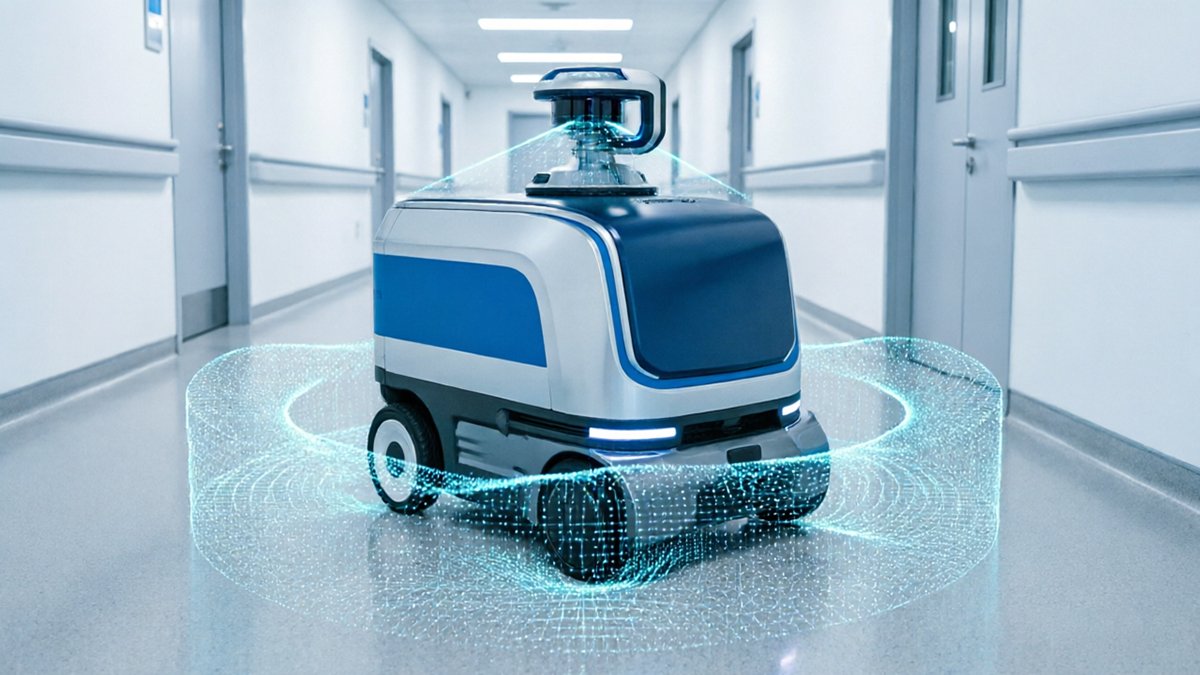
Visualizing the Path: LiDAR Data Processing in Medical AMRs
Raw point cloud data doesn’t guide a robot — processed, filtered, and structured environmental intelligence does. Understanding that pipeline reveals why 3D LiDAR is the backbone of reliable medical AMR navigation.
Point cloud-to-grid conversion is the foundational step in turning millions of sensor readings into actionable path plans. The robot’s onboard processor voxelizes incoming 3D point data — grouping spatial coordinates into discrete cells — then projects that volume downward into a 2D occupancy grid. Each cell is classified as free, occupied, or unknown. The path planner queries this grid in real time, calculating trajectories that thread through corridors without collision. Without accurate point cloud capture, the grid degrades, and so does every downstream decision.
Reflective surfaces are a persistent challenge in clinical environments. Polished linoleum floors, stainless steel equipment carts, and IV pole bases generate spurious returns that inflate the occupancy grid with phantom obstacles. Effective AMR software stacks apply intensity thresholding and return filtering — discarding returns that exceed expected reflectance profiles or arrive outside plausible range windows. The result is a clean, trustworthy map even in environments designed for sterility rather than sensor compatibility.
The video below demonstrates LiDAR obstacle avoidance in a live hospital corridor setting, showing how the system responds to a gurney crossing the robot’s planned route:
[EMBED: YouTube video — LiDAR obstacle avoidance demo in hospital corridor]
Technical takeaway 1: Notice how the costmap updates around the gurney’s leading edge within milliseconds — this is the 20Hz refresh cycle discussed earlier translating into visible trajectory replanning.
Technical takeaway 2: The high-precision docking of wheelchairs/beds through LiDAR is visible in the final approach sequence, where the robot slows and re-angles to align within centimeters of the target.
Technical takeaway 3: Multi-return processing allows the sensor to distinguish the gurney frame from the floor reflection beneath it — a capability single-return systems cannot replicate.
LiDAR-inertial SLAM extends this pipeline across entire facilities. By fusing LiDAR point clouds with IMU acceleration data, LiDAR-inertial SLAM maintains consistent localization even when elevators disrupt GPS-denied positioning or when corridor geometry repeats across floors. Visual markers — QR codes or AprilTags at elevator landings — provide absolute pose corrections, anchoring the inertial drift that accumulates between floors. This multi-layer approach, detailed in PMC research on smart patient care robots, enables robots to operate seamlessly across complex, multi-level medical facilities without manual re-localization. As hospital fleets scale beyond pilot programs, that architectural robustness becomes a procurement criterion as much as a technical one.
Procurement Realities: Balancing Precision with Hardware Scalability
Scaling a medical delivery robot from prototype to hospital fleet isn’t just an engineering challenge — it’s a procurement challenge that determines whether a product survives contact with real-world budgets.
The shift from R&D to fleet-wide deployment changes everything about how hardware is sourced. In the early prototype phase, teams can absorb premium pricing from distributors and accept long lead times. But once a hospital network commits to 20, 50, or 100 units, the per-sensor cost and supply chain reliability become mission-critical variables. A single sourcing bottleneck can delay an entire deployment contract.
Direct procurement is increasingly replacing the traditional distributor model for exactly this reason. Buying directly from sensor manufacturers — rather than through regional middlemen — cuts significant margin out of the chain and gives engineering teams direct access to firmware updates, calibration data, and component-level specifications. As LidarStar’s affordable sensor platform demonstrates, factory-direct pricing is no longer reserved for automotive OEMs; robotics startups can access the same supply tiers when volume thresholds are met.
This matters because, as industry analysis confirms, automotive-grade LiDAR sensors are increasingly crossing over into medical robotics due to their mass-production reliability and rigorous durability standards. That durability translates directly into clinical uptime — a sensor rated for automotive temperature cycling and vibration tolerance will handle the demands of a busy hospital corridor without issue. However, teams should verify that sensors carry triple certification — covering safety, electromagnetic compatibility, and environmental protection — before specifying hardware for medical environments where regulatory scrutiny is high.
For startup R&D leads, global shipping logistics and responsive technical support are equally non-negotiable. A sensor that ships in 48 hours from a manufacturer with English-language engineering support is fundamentally more valuable than a marginally cheaper component with a six-week lead time and no escalation path. Understanding how sensor architecture affects long-term reliability at scale helps procurement teams ask the right questions before committing to a supply relationship.
With those hardware fundamentals in place, the remaining question is how all of these technical and commercial considerations translate into actionable guidance — which the key takeaways ahead distill directly.
The Bottom Line: Key Takeaways for Medical Robotics Leads
Medical robotics leads evaluating sensor architecture need one clear principle: 3D LiDAR isn’t a premium upgrade — it’s the minimum viable specification for safe hospital deployment.
The case for 3D LiDAR in clinical environments comes down to five non-negotiable realities:
- Low-profile obstacle detection is irreplaceable. Wheelchair footplates, IV poles, and floor-level equipment sit below the scan plane of 2D LiDAR. Only volumetric 3D point clouds capture the full vertical geometry of a corridor, catching hazards that flat-plane sensors miss entirely.
- Frame rate determines collision safety. A minimum 10–20Hz scan frequency is required to track obstacles moving at 1.5m/s — the pace of a brisk hospital walk. Drop below that threshold and the robot’s reaction window collapses, especially around blind corridor corners.
- SLAM accuracy eliminates drift in featureless environments. Long, uniform hospital hallways offer few visual anchors. LiDAR-based SLAM delivers the zero-drift positioning needed to maintain reliable routes across repeated shifts — something camera-only systems struggle with as lighting and crowd density shift. Explore how 3D point cloud depth directly reduces collision rates compared to 2D alternatives.
- Precision enables shared infrastructure. Sensors with ±2cm positional accuracy allow robots to pass through standard 32-inch doorways alongside human traffic without dedicated robot lanes or costly facility modifications. According to Frontiers in Bioengineering and Biotechnology, precision docking and obstacle avoidance rank as the two most critical safety benchmarks for medical service robots — and both depend directly on sensor resolution.
- Automotive-grade sensors cut procurement cost without cutting safety. Direct sourcing of high-volume automotive LiDAR hardware brings per-unit costs down significantly while still meeting the accuracy and reliability thresholds that clinical environments demand.
The engineering decisions covered across this article — from point cloud filtering to SLAM architecture to procurement strategy — all converge on these five pillars. Robotics leads who anchor specifications to them will build fleets that perform on day one and scale without costly retrofits. Still have questions about specific hardware trade-offs, reflective floor interference, or how robots distinguish patients from equipment? The next section addresses the most common technical questions directly.
Frequently Asked Questions: Hospital LiDAR Navigation
3D LiDAR in hospital environments raises real engineering questions — and the answers shape whether a deployment succeeds or stalls at pilot stage.
How does LiDAR handle highly reflective hospital floors?
Reflective surfaces are a known challenge for LiDAR systems, but modern sensors address this directly. Intensity data embedded in each return signal lets the filter stack distinguish between a mirror-like epoxy floor and a solid obstacle sitting on top of it. Point cloud filtering techniques — similar to those used in adverse outdoor conditions — suppress ghost returns without eliminating legitimate detections. In practice, well-tuned intensity thresholds keep navigation reliable even on high-gloss hospital floors.
Can 3D LiDAR detect clear plastic IV bags or glass partitions?
TransparenTransparent and semi-transparent materials return weaker signals, which is a genuine limitation. Clear IV bags hanging from poles may register inconsistently, and glass partitions can produce partial or no returns. The practical mitigation is sensor fusion — pairing LiDAR with depth cameras or ultrasonic sensors to cover these edge cases. Neither sensor type alone solves every scenario, so hybrid perception stacks remain the standard approach in clinical deployments.
What is the difference between mechanical and solid-state LiDAR for medical robots?
Mechanical LiDAR uses spinning components to achieve wide horizontal field of view, while solid-state LiDAR has no moving parts, offering greater durability and a smaller form factor. For hospital robots that operate continuously across multi-shift schedules, solid-state designs reduce mechanical wear and maintenance overhead — a meaningful operational advantage over a multi-year fleet lifecycle.
How do robots differentiate between a patient and a piece of equipment?
Object classification relies on point cloud shape analysis combined with machine learning models trained on clinical environments. Research into sensor proximity gaps shows that near-field blind spots can cause misclassification at close range, reinforcing why overlapping sensor coverage matters. Height, volume, and movement patterns together inform whether a detection is a person or a stationary cart.
What is the typical range needed for indoor hospital navigation?
Effective corridor navigation generally requires reliable detection between 0.1 m and 20 m. Most hospital hallways fall well within this envelope, but elevator lobbies and open atrium spaces can push detection demands toward the higher end. A sensor with strong near-field resolution — under 0.5 m — is equally critical, since patients and staff frequently enter a robot’s path at close proximity with little warning.