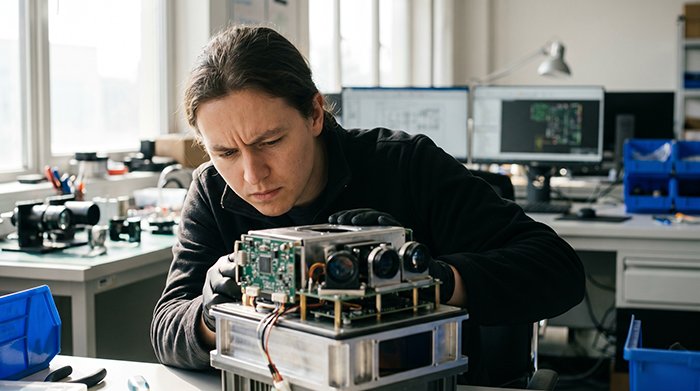
Two fundamentally different physical principles separate legacy LiDAR from the next generation — and that gap now determines whether autonomous vehicles can safely navigate the real world.
ToF operates like a stopwatch. The sensor fires a discrete laser pulse, then counts the nanoseconds until that pulse returns. As detailed in LidarStar’s detailed technical overview, ToF sensors calculate distance by measuring the time it takes for a light pulse to bounce off an object and return to the detector — a clean, proven method. The LakiBeam 1S model is a practical example of this pulsed methodology applied to industrial-grade 2D sensing. The core limitation isn’t accuracy — it’s what a single pulse cannot tell you beyond raw range.
FMCW LiDAR takes a fundamentally different approach. Instead of discrete pulses, it transmits a continuous laser beam whose frequency is swept in a precise, linear chirp pattern. When that signal reflects back, the sensor compares the returning wave’s frequency shift against what was originally transmitted. This comparison, known as coherent detection, extracts both distance and relative velocity simultaneously from a single measurement event — something pulse-based architectures simply cannot replicate in one shot.
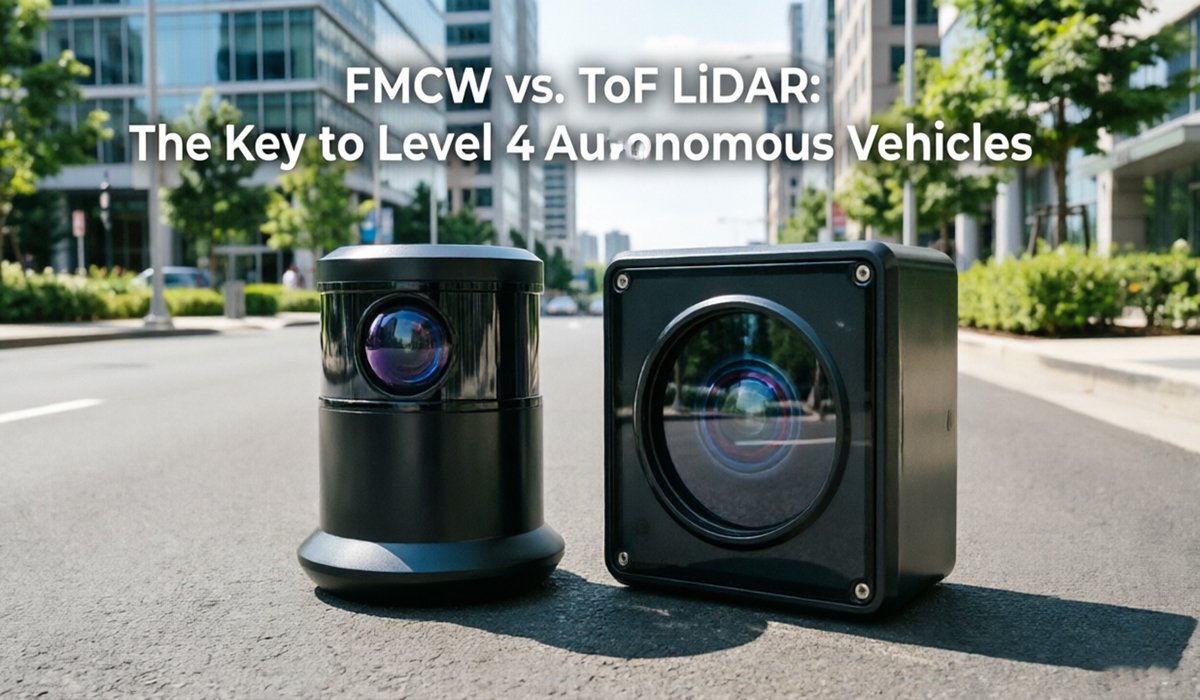
Here’s the conceptual contrast at a glance:
- Pulse-based ToF: Emit → Wait → Detect → Calculate distance only
- FMCW: Transmit continuous chirp → Mix return signal → Extract range and Doppler data together
The industry’s shift from ToF to FMCW LiDAR reflects a broader realization: autonomous driving at Level 4 demands complex signal intelligence, not just precise range measurements. That intelligence starts with velocity — and how each architecture handles it changes everything.
The Velocity Advantage: Why Single-Frame Data Changes Everything
Instantaneous velocity measurement is the single most consequential difference between FMCW and legacy ToF LiDAR — and it may determine whether a vehicle stops in time or doesn’t.
ToF LiDAR calculates object speed the hard way: by comparing position across multiple sequential frames. That process introduces inherent latency — the system must wait for at least two data captures before it can estimate how fast something is moving. At highway speeds, even a 50-millisecond delay translates to several feet of unaccounted motion. For collision avoidance algorithms, that margin isn’t acceptable.
FMCW takes a fundamentally different approach by exploiting the Doppler effect. Because FMCW continuously sweeps a frequency-modulated laser, a returning signal from a moving object arrives at a slightly shifted frequency. The system reads that frequency shift directly, extracting velocity data from the same single frame that captures range. According to Scientific Reports article, this method delivers instantaneous velocity precision of 0.1 meters per second per frame — a level of accuracy that transforms how autonomy stacks make real-time decisions.
The downstream impact on safety systems is significant:
- Braking distance calculations become proactive rather than reactive — the vehicle knows a car ahead is decelerating before it visibly moves in the point cloud
- Collision avoidance algorithms can act on intent, not just position
- Trajectory prediction models gain richer input data from a single scan cycle
As McKinsey’s analysis notes, FMCW is “the only technology that can simultaneously provide high-resolution range and instantaneous velocity, which is the ‘holy grail’ for autonomous driving safety.”
This is the leap from 3D point clouds — static snapshots of geometry — to true 4D sensing, where the fourth dimension is live velocity. You can explore how point cloud dimensionality shapes autonomy decisions in more depth elsewhere.
However, velocity precision alone isn’t the full story. How a sensor performs when dozens of other vehicles are broadcasting their own laser signals in the same urban corridor raises an equally critical challenge.
Solving the Interference Problem in Dense Urban Environments
ToF LiDAR’s significant blind spot isn’t distance — it’s noise. In dense urban environments, lidar for autonomous vehicles must contend with a relentless barrage of competing signals: direct sunlight, reflected light from wet pavement, and pulses broadcast by dozens of nearby sensor systems. For traditional ToF sensors, any photon arriving at the detector during a measurement window looks like a valid return. There’s no built-in mechanism to distinguish “my pulse” from “everything else.”
The core vulnerability of ToF is its passive acceptance of ambient photons. Bright sunlight saturates detectors. Oncoming vehicles equipped with similar sensors inject identical wavelength pulses into the scene. The result is ghost returns, dropped points, and degraded point clouds — exactly the conditions a safety-critical autonomy stack cannot tolerate.
FMCW flips this dynamic entirely through coherent detection. Rather than measuring raw pulse arrival time, FMCW systems encode each transmission with a unique, continuously swept frequency ramp. The receiver only responds to returns that match the precise frequency signature it generated — a process validated by IEEE Xplore article confirming FMCW’s inherent immunity to solar glare and cross-sensor interference. Think of it as a private encrypted channel — competing signals simply don’t hold the right key.
This coherent architecture also delivers measurable signal-to-noise ratio benefits in adverse weather. In fog or rain, ToF systems accumulate backscatter from suspended particles, degrading range accuracy. FMCW’s advanced frequency-domain processing naturally suppresses incoherent backscatter, preserving usable returns at distance. According to PatSnap’s technical analysis, this noise rejection is structural — baked into the physics, not patched in software.
That resilience to noise sets the stage for another critical performance gap: detecting low-reflectivity hazards that ToF systems routinely miss.
Sensitivity and Range: Detecting the ‘Dark’ Hazards
A shredded truck tire lying flat on a dark highway at 3 a.m. is one of the most dangerous obstacles a Level 4 vehicle can encounter — and ToF LiDAR often can’t see it until it’s too late.
ToF’s core weakness is its reliance on intensity-based detection. It measures how much laser light bounces back from a surface. Dark objects — black rubber, matte-painted vehicles, wet asphalt — absorb photons rather than reflecting them. At highway speeds, that narrow detection window can compress reaction time to near zero.
FMCW takes a fundamentally different approach. Instead of measuring return intensity, it detects the frequency shift between the transmitted and received signal. Because the detection mechanism is coherent — comparing waveform phase rather than counting photons — it isn’t defeated by low-reflectivity surfaces in the same way. According to SEMI-cited technical research, FMCW systems can achieve a dynamic range exceeding 100 dB, enabling reliable detection of low-reflectivity objects at distances beyond 200 meters.
The safety math here is stark. At 70 mph, a vehicle travels roughly 103 feet per second. Detecting a dark obstacle at 200+ meters instead of 50 meters provides approximately four additional seconds of reaction time — enough for both automated braking systems and emergency maneuver planning to execute fully.
Instantaneous velocity data compounds this advantage. Because FMCW captures speed in a single frame alongside distance and reflectivity, the system simultaneously knows where that dark object is and whether it’s moving — critical for distinguishing a stopped vehicle from a slow-rolling debris field.
Understanding this sensitivity gap helps clarify why FMCW suits high-speed detection scenarios so well — though it’s worth examining where legacy ToF technology still holds meaningful ground.
Where ToF Still Leads: Maturity, Scale, and Integration
ToF remains the dominant sensor technology for production-grade autonomy today — and for good reason. Despite FMCW’s compelling advantages in velocity detection and coherent detection sensitivity, dismissing ToF as obsolete misreads the current landscape entirely.
As Innoviz Tech notes, ToF technology is the established standard for mass-produced ADAS systems, backed by a mature global supply chain and lower computational overhead than FMCW signal processing demands. Decades of manufacturing refinement mean ToF components are cheaper, more available, and easier to integrate into existing hardware stacks.
In practice, this maturity translates directly into deployment scale. Warehouse robotics and autonomous mobile robots (AMRs) represent one of ToF’s strongest strongholds. These environments — controlled, well-mapped, and operating at low speeds — don’t require Doppler velocity data or extreme range sensitivity. A cost-effective ToF sensor solves the problem cleanly. Understanding how 2D and 3D sensing trade-offs play out in these real-world deployments further illustrates why sensor choice is always application-driven.
ToF strengths worth acknowledging:
- Maturity: Proven in millions of deployed units across automotive, robotics, and industrial settings with well-understood failure modes.
- Cost: Lower bill-of-materials and simplified receiver architecture compared to the optical coherence requirements of FMCW.
- Simplicity: Reduced signal processing burden makes real-time integration into existing ADAS compute platforms more straightforward.
FMCW, by contrast, still faces meaningful chip-scale integration challenges — particularly in miniaturizing coherent optical components at automotive production volumes and price points.
The honest conclusion is that “best” depends entirely on the operational design domain (ODD). Level 2+ highway assist in a controlled environment? ToF delivers. Unstructured urban robotaxi operation at speed? That’s where FMCW’s architecture earns its complexity premium — a gap that silicon photonics advances are now working to close.
The Path to Commercialization: Silicon Photonics and Scaling
FMCW LiDAR’s greatest engineering challenge has never been physics — it’s been packaging those physics into something a vehicle can afford and sustain at scale.
The core bottleneck has long been component complexity. Early FMCW systems required discrete optical benches, tunable lasers, and fiber-optic combiners — too bulky and expensive for any production vehicle. Silicon photonics changes that equation fundamentally. By fabricating optical components directly onto silicon wafers using standard semiconductor processes, engineers can integrate waveguides, modulators, and photodetectors onto a single chip. According to Laser Focus World, this transition is expected to significantly reduce the footprint and complexity of FMCW systems over the next decade.
This is the “LiDAR-on-a-chip” trend — and it’s the unlock that makes 4D sensing economically viable for mass automotive production.
The architectural shift also forces a rethinking of scanning strategy. Mechanical spinning assemblies — the rotating drums familiar from early autonomous platforms — offer wide field-of-view coverage but introduce moving parts that fail under vibration and thermal stress. Solid-state alternatives, including optical phased arrays and MEMS mirrors, eliminate those failure points. The trade-off is real, though: solid-state architectures currently sacrifice some angular resolution and require more sophisticated beam-steering algorithms. In practice, hybrid approaches — solid-state for near-field, limited mechanical sweep for long-range — are bridging the gap during this transitional period.
As explored in our overview of how LiDAR sensing has evolved, the progression from simple distance measurement to full velocity-plus-position data reflects a broader maturation curve. Most analysts place meaningful FMCW automotive volume production between 2027 and 2030, contingent on yield improvements in photonic chip fabrication. That timeline has direct implications for procurement strategy — a topic the next section addresses in depth.
Strategic Procurement: Choosing the Right Sensor for Your ODD
Matching sensor technology to your Operational Design Domain is the single most cost-effective decision an engineering team can make before a procurement order ships.
The decision framework starts with environment. ToF-optimal deployments share three common traits: controlled or indoor settings, speeds below 25 mph, and predictable lighting conditions. Warehouse AMRs, factory floor navigation, and low-speed campus shuttles fit this profile cleanly — and a proven high-channel ToF platform delivers the resolution and reliability those applications need at a lower unit cost.
FMCW-essential environments look entirely different:
| ODD | Recommended Tech | Key Reason |
|---|---|---|
| Highway (65+ mph) | FMCW | Instantaneous velocity per point |
| Dense urban intersection | FMCW | Interference immunity in high-sensor-density zones |
| Mixed-traffic robotaxi route | FMCW | Doppler-based ghost rejection |
| Indoor logistics hub | ToF | Cost efficiency, controlled lighting |
| Low-speed campus shuttle | ToF | Mature toolchains, proven safety records |
For high-speed outdoor deployments, interference immunity isn’t a checkbox — it’s a non-negotiable safety requirement once vehicle density reaches real-world urban scale. FMCW’s coherent detection architecture handles that by design, where ToF simply cannot.
Factory-direct sourcing becomes critical as programs move toward production. R&D budgets tighten between prototype and pilot fleet stages, and per-unit cost reductions only materialize when procurement bypasses distribution markups. LidarStar maintains a catalog spanning 2D navigation sensors through 128-channel 3D systems with factory-direct pricing — giving engineering leads access to the full stack without intermediary overhead.
Technical support requirements for 4D sensor integration also differ materially from traditional ToF programs. Doppler processing pipelines, point-cloud fusion with IMU data, and real-time velocity filtering require vendor engagement that goes beyond a datasheet. Prioritize suppliers offering direct engineering support, not just a reseller hotline. The takeaways for how these procurement priorities translate into program strategy come next.
The Bottom Line: Key Takeaways for Engineering Leads
The choice between ToF and FMCW LiDAR is ultimately a decision about which safety tier your system is engineered to meet. As Laser Focus World notes, “FMCW LiDAR is the future of high-performance sensing” — and for Level 4 programs, that future is arriving faster than procurement cycles can afford to ignore.
Here are the four decisions that should drive your next sensor evaluation:
- ToF serves today’s deployments; FMCW defines tomorrow’s safety ceiling. ToF technology remains a proven, cost-effective solution for structured environments and ADAS-level applications. However, Level 4 certification requirements — particularly around edge-case collision scenarios — increasingly demand the richer data profile that FMCW delivers.
- Instantaneous velocity is the primary differentiator for collision avoidance. FMCW sensors capture per-point Doppler velocity data natively, without requiring multi-frame processing. In practice, this means a vehicle can distinguish a pedestrian stepping into traffic from a stationary object in under a single scan cycle — a capability ToF architectures cannot replicate at equivalent latency.
- Interference immunity is non-negotiable for urban scaling. Deploying fleets in dense urban corridors means hundreds of active sensors sharing the same physical space. FMCW’s coherent detection architecture rejects crosstalk that would degrade ToF point clouds, making it the only viable path to reliable, city-scale autonomous operation.
- Procurement strategy should prioritize certified hardware and direct support channels. Sensor quality and supplier accountability directly affect system uptime. Teams sourcing at scale should evaluate certified procurement options that provide both validated hardware and responsive technical support.
The engineering case for FMCW is clear. The questions that remain — around cost curves, specific deployment contexts, and hybrid architectures — are precisely what the following FAQ section addresses directly.
Frequently Asked Questions: FMCW vs. ToF LiDAR
The most debated questions in autonomous sensor selection come down to real-world performance trade-offs that spec sheets alone can’t answer.
Which is more suitable for autonomous driving at Level 4: FMCW or ToF?
FMCW is the stronger fit for Level 4 autonomy, where deterministic safety guarantees are non-negotiable. Its ability to simultaneously resolve range, velocity, and reflectivity in a single measurement cycle gives perception stacks richer data with lower latency. ToF remains a proven, cost-effective option for lower-autonomy tiers where those guarantees are less critical, as noted in the ongoing FMCW vs. ToF debate.
Can ToF LiDAR measure velocity?
Yes — but indirectly. According to 21ic.com article, ToF must calculate velocity by comparing distance changes across multiple consecutive frames, introducing algorithmic delay and potential error. FMCW measures velocity instantly via the Doppler frequency shift embedded in the returned signal — a meaningful advantage when tracking fast-moving objects.
Why is FMCW more resistant to sunlight and interference?
FMCW uses coherent detection, meaning the receiver only responds to light that matches its own transmitted frequency signature. Ambient sunlight and competing sensor pulses fail that match test and are filtered out. This is a fundamental architectural advantage over direct-detection ToF, which is vulnerable to photon noise from any bright source. The Sensor Tips FAQ series covers this coherence principle in technical depth.
Is FMCW LiDAR currently available for industrial use?
Yes. While early FMCW systems were primarily research-grade, commercial deployments are actively expanding. AEye’s documented timeline illustrates how the technology has matured from laboratory prototypes into production-ready hardware targeting robotaxis, industrial automation, and smart infrastructure — with adoption accelerating through 2025 and beyond.