A pose stream starting near zero after a configuration change does not establish that relative and differential fusion are equivalent. In the reviewed robot_localization ROS 2 documentation, relative handling references a sensor’s pose measurements to an initial measurement, while differential handling converts pose changes into velocity information. They answer different questions about what the filter should receive.
Begin by identifying whether the input supplies pose, twist or another measurement, and which variables are selected for fusion. Preserve its original sequence, timestamps, frame and covariance. A new plot can look smoother or begin at a more convenient origin while representing a different measurement contract. That appearance is insufficient to decide which setting is appropriate.
The duplicate-odometry audit addresses a separate issue: shared measurement origins. Neither flag creates independent evidence from duplicated inputs. This article instead compares reference handling, pose-to-velocity conversion and restart behavior, using version-qualified upstream references rather than a universal parameter recipe for every LiDAR estimator.
State the question each setting is meant to answer
The reviewed ROS 2 state-estimation documentation distinguishes the two operations. A relative reference is useful to examine when measurements should be interpreted from a session’s initial pose. Differential processing instead changes the form of pose information by deriving velocity from successive pose changes. Confirm the deployed release’s support and behavior before applying either description.
Write the desired consumer contract before editing flags. Do you need an absolute pose in a shared map, displacement from one sensor’s first accepted pose, or velocity information derived from its pose sequence? These alternatives preserve different information. A parameter selected merely because it removes an inconvenient offset can unintentionally discard an absolute reference that another part of the application requires.
Use the heading-reference workflow when the apparent offset is actually a world-convention disagreement. Referencing a trajectory to its first measurement does not prove that geographic heading, sensor axes or mounting transforms are correct. Preserve those distinctions so a convenient zero origin does not conceal a coordinate error.
| Question | Relative handling | Differential handling |
|---|---|---|
| Primary distinction | Initial pose reference | Pose changes converted to velocity |
| Information to retain | First accepted pose and frame | Successive accepted poses and times |
| Common confusion | Zero origin proves correct frames | Derived velocity equals original absolute pose |
| Restart comparison | Identify reference initialization | Identify previous-measurement history |
| Independent evidence | Does not create it | Does not create it |
Inspect the actual input type and selected variables
The upstream ROS 2 parameter example documents the per-input flags and notes that differential handling applies to pose measurements. Its comments distinguish relative reference handling from conversion to velocity. Read the installed source and effective input configuration as well, because an example on a moving upstream branch is not a guarantee of every binary’s defaults.
Record whether the message contains pose and twist, and which variables the filter actually accepts. An Odometry message can carry both, but choosing a differential flag does not mean all fields undergo the same operation. Inspect the configured variable selection, sensor topic and any preprocessing wrapper. A familiar message type or parameter prefix cannot replace that per-variable inventory.
The effective parameter diagnostic helps establish that the intended node loaded the intended values. Capture relative and differential settings from the running instance, not just a saved file. Keep node identity and namespace in the record when multiple estimators or launch includes can override an input configuration.
Preserve the initial reference as an explicit observation
The Jazzy stamped pose contract carries the frame, time and pose-with-covariance container. Retain those values for the first accepted input and later samples. When interpreting a relative pose, use the supported pose-reference operation; do not subtract quaternion components as though orientation were an ordinary three-component position vector.
Compare a bounded trajectory with an independently recorded starting condition. Preserve both the original absolute input and the representation accepted by the filter. If the initial sensor measurement changes between runs, a changed relative origin may be expected. That is different from an unexplained change during one continuous run, and it should appear as a separate observation in the support record.
The transform timing diagnostic is relevant when the first accepted sample differs because transforms were unavailable. Record which measurement actually established the reference, not simply which packet arrived first at a recorder. Startup timing, rejected samples and frame availability can affect the observed initialization boundary.
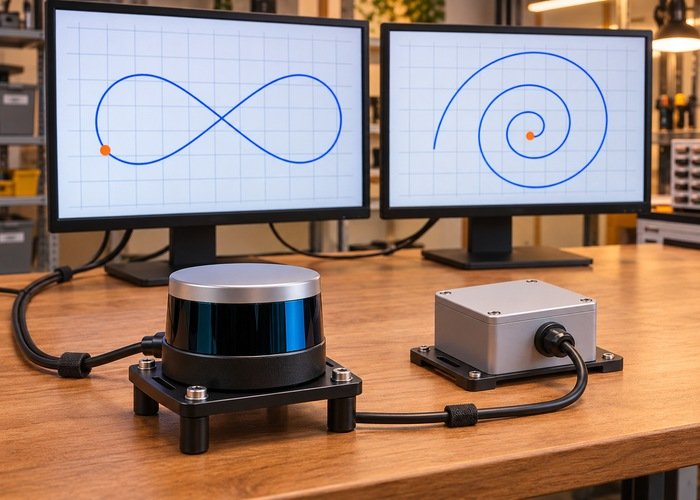
Treat derived velocity as a different measurement
The Jazzy stamped twist definition provides a useful contrast with a pose container. A velocity estimate has its own reference, time and uncertainty meaning. When pose changes are differentiated, the time interval and accepted sample sequence matter. Do not treat the resulting information as an unchanged absolute pose with its origin removed.
Use a controlled sequence containing stationary intervals, motion and a pause in delivery. Preserve acquisition timestamps and arrival times separately. Compare the installed filter’s behavior without silently changing the sampling sequence between tests. Review the documented covariance considerations for differential orientation processing, especially where no independent absolute orientation measurement is fused; avoid inventing a tuning value to suppress the symptom.
Inspect interval irregularity before blaming the relative reference. A delayed or missing sample changes the evidence available to a time-based operation. Do not relabel an older measurement with the current clock merely to make a plot look regular. State which timestamps were used and keep the original capture so the same sequence can be replayed for diagnosis.
Compare restart behavior without confusing it with steady operation
The reviewed ROS 2 filter implementation is the appropriate place to investigate a specific unresolved preprocessing or initialization boundary. Pin the code revision and installed package. Source inspection should answer a concrete question about which reference or previous measurement state is retained, rather than being used to justify an untested configuration copied from another robot.
Run the same bounded input through separate, clearly identified initializations. Compare the first accepted pose, resulting reference and later trajectory. Then distinguish that startup comparison from a change made while an existing process retains state. A restart can change the reference history; it is not equivalent to merely changing the graph’s visible topic name or restarting a plotting application.
Prepare a reproducible fusion support bundle with original samples, effective flags, selected variables and initialization events. Include the outcome that would satisfy the intended contract. The useful result is a justified choice about retained reference information and measurement form, not simply a trajectory that begins at zero.
Frequently asked questions
Does differential mean the same thing as starting at zero?
No. The reviewed documentation distinguishes pose-to-velocity conversion from referencing measurements to an initial pose. Decide which measurement representation is required instead of selecting a flag solely from the plot’s initial offset.
Will differential processing change an input that only provides twist?
The reviewed upstream parameter example notes that differential pose handling does not affect twist measurements in that way. Check the actual input type, selected variables and installed version instead of assuming a flag changes every field.
Can relative handling fix a mounting or heading error?
A new reference origin does not establish correct axes, transforms or geographic conventions. Validate the numerical pose and frame contract separately. A convenient starting position can coexist with an incorrect orientation relationship.
Should both flags always be enabled together?
Do not use a universal combination. Determine which information must remain absolute, which reference should be retained and which measurement form the consumer needs. Inspect supported interactions in the deployed source and verify them with the same bounded input.