A 2D LiDAR sensor in ROS 2 can make a mobile robot feel predictable, but only when the sensor, transforms, scan topic, and navigation stack are checked as one system. Many teams can display a laser scan once. Fewer teams can keep that scan stable while the robot turns, maps, avoids people, and returns to a dock. This guide starts from the field problem: you have a sensor on a robot, and you need the data to become reliable navigation behavior.
The quick answer is to treat setup as a chain. Confirm power and data first, publish a clean LaserScan, define the sensor frame, connect it to base_link, inspect the result in RViz, then test the route before tuning navigation. If one link in that chain is vague, the robot may map poorly or stop for the wrong reason.
Start With The Physical Mount
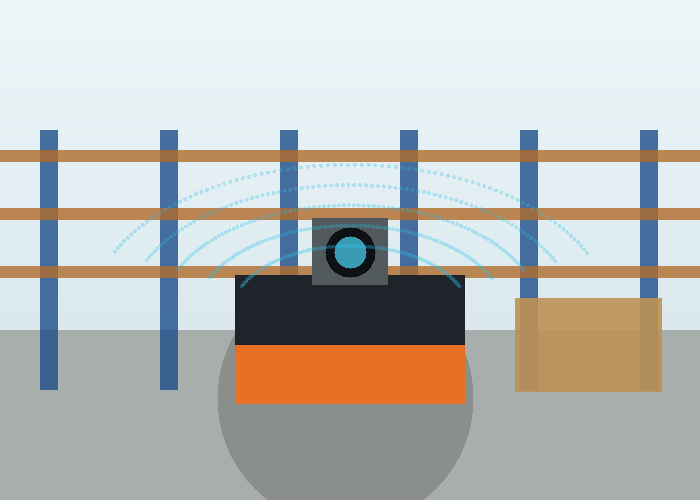
Before opening a launch file, look at the robot. The LiDAR window needs a clear scan plane across the objects that matter: cart edges, chair legs, pallet corners, shoes, low boxes, and docking fixtures. If the sensor sits behind a bumper or decorative shell, the scan may look active while still missing the real obstacle zone.
Mount height is a practical decision, not a cosmetic one. A high mount may ignore floor-level objects. A low mount may see thresholds, floor shine, or dust. For warehouse and lab pilots, use the robotics LiDAR application page and the industrial automation LiDAR page as internal references for route-driven selection rather than spec-sheet guessing.
Confirm The LaserScan Before Navigation
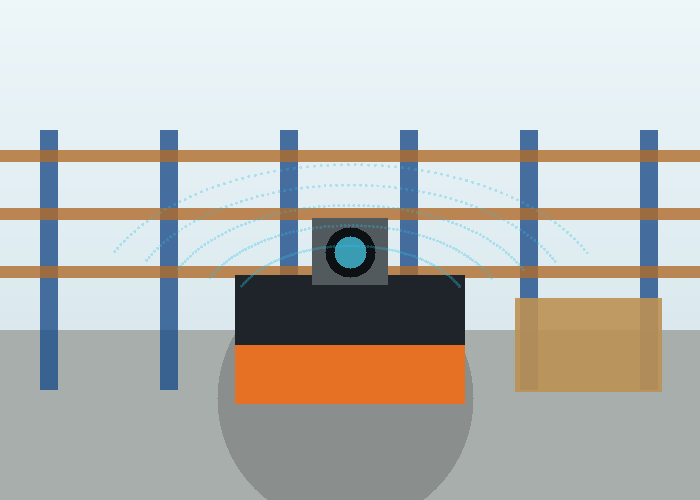
A basic ROS 2 setup should publish a scan topic, often as sensor_msgs/LaserScan. Do not rush past this step. Rotate the robot slowly by hand, place objects at known distances, and check whether the scan angle, direction, and range limits make sense. If the scan appears mirrored or offset, solve that before building a map.
The official ROS 2 tf2 documentation explains why transforms are central: the robot needs to know where each frame is over time. The Nav2 transform setup guide also notes that sensor frames such as lidar_link or base_laser need a transform back to base_link. That is often where early setup problems hide.
Use A Frame Tree That A Future Teammate Can Understand
For a normal mobile robot, keep the frame story simple. The map frame represents the global map. The odom frame supports locally continuous motion. The base_link frame is attached to the robot body. The laser frame is attached to the sensor. The ROS REP 105 coordinate frame convention gives the reference model for these mobile platform frames.
A common beginner mistake is treating the sensor frame like a label instead of a measurement. If the LiDAR is 18 cm forward and 12 cm above base_link, that offset should be represented in the transform. If the sensor is rotated, that rotation also matters. Small errors can become large navigation surprises near walls, pallets, and docking targets.
| Check | What to verify | Why it matters |
|---|---|---|
| Scan topic | Stable LaserScan values while objects move | Confirms the driver and range settings |
| Sensor frame | Correct laser frame name and orientation | Prevents mirrored or shifted scans |
| base_link transform | Measured offset from robot body to sensor | Keeps obstacles in the correct place |
| RViz view | Scan lines match real objects | Catches setup errors before mapping |
| Route test | Robot sees low and side objects | Validates real operating scenes |
RViz Checks That Save Time
RViz should become a measurement tool, not only a nice screen. Place a box directly in front of the robot and measure the distance. Move the box to the left side, right side, and near a corner. The scan should move in the same direction you expect. If the object moves right in the room but left in RViz, stop and fix the frame or orientation.
Then add a fixed object that the robot will see every day, such as a dock face, rack leg, chair base, or wall edge. If the scan drifts while the robot is stationary, look for vibration, cable issues, weak power, timestamp problems, or a driver configuration mismatch.
Connect Setup To Navigation Behavior
Nav2 turns sensor data into planning and control behavior. Its documentation describes a navigation framework that includes perception, planning, control, localization, and behavior management. The Nav2 mapping and localization guide points to SLAM tooling for building maps and localizing a robot, while the broader Nav2 documentation helps teams understand how the stack fits together.
The practical point is simple: navigation quality depends on input quality. A noisy scan can inflate obstacles badly. A wrong frame can place walls in the wrong location. A loose bracket can create ghost obstacles. Before tuning planners, make the sensor story boring and repeatable.
A Field Test Before The First Map
Run a short field test before creating the map. Put five objects in the route: a low box, a dark object, a shiny object, a narrow chair leg, and the actual docking surface. Move each object a little between trials. The goal is not to prove the sensor is perfect. The goal is to discover where the scan plane is strong and where it needs adjustment.
NIST research on mobile robotics systems and standard test methods is useful because it pushes teams toward repeatable tests instead of one polished demo. A setup that passes a repeatable route test is more valuable than a setup that only looks good during one clean run.
When The Map Looks Wrong
If the map bends, doubles walls, or shows obstacles that are not there, check timing, odometry, transform direction, scan orientation, and mounting stiffness. Do not immediately blame the navigation stack. Most early mapping problems come from basic data alignment and movement estimation.
If the robot maps well in a small room but fails in a long corridor, check reflectivity, range limits, wheel slip, and whether the sensor sees enough geometry for localization. If the robot maps well empty but fails with payload, the payload may be blocking the scan or changing vibration.
Buying And Selection Notes
When comparing sensors through the LidarStar LiDAR sensor category, match the choice to route evidence. For compact indoor robots, scan angle, update rate, minimum range, interface, and ROS driver readiness can matter more than headline maximum range. For factory routes, environmental protection, mounting options, and repeatability may dominate the decision.
A practical request through the LidarStar request page should include robot size, planned mounting height, scan topic needs, route photos, smallest object to detect, indoor or outdoor conditions, and the expected controller or computer interface. That gives an engineer enough context to recommend a setup instead of guessing.
Field Notes To Capture During The Pilot
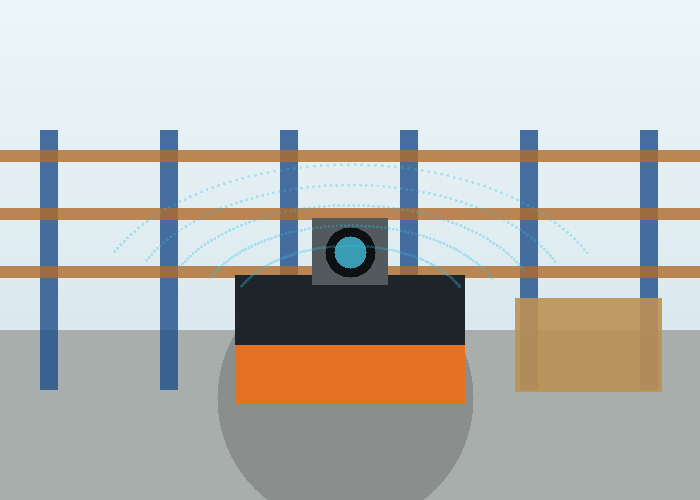
A useful pilot log is short, factual, and tied to the route. For 2D LiDAR sensor in ROS 2, record the mounting position, object used in the test, robot speed, lighting or floor condition, software version, and the result you observed. Avoid vague notes such as “worked” or “failed.” Write what happened: the robot saw the low carton at the first mark, the scan jumped near the glossy threshold, the estimate drifted after the second turn, or the cloud kept rack legs but removed isolated dust points.
Photos matter because they keep the team honest. Take a front view, side view, sensor close-up, route view, and problem-object view. If the test includes a dock, rack, elevator, doorway, or outdoor transition, photograph that scene from the robot’s height as well as from a standing human view. The robot does not experience the world from eye level, and many early mistakes come from reviewing a route from the wrong height.
A short phone video is often more useful than a long written report. Walk behind the robot during one clean run and one difficult run. Keep the target object in view. When the robot hesitates, stops, or recovers, say the scene out loud. Those details help engineering, operations, and purchasing discuss the same evidence instead of debating memory from a demonstration.
A Simple Acceptance Checklist
Before calling the pilot ready, run the same route at least three times without changing the setup. The robot should behave consistently in clean conditions, then continue to behave reasonably when a realistic object is added. If the result changes every run, do not tune around the problem yet. First find whether the variation comes from mounting, timing, calibration, floor condition, object placement, or software state.
The checklist should include detection, stability, response, recovery, and maintenance. Detection asks whether the system sees the target object. Stability asks whether the measurement stays believable while the robot moves. Response asks whether the robot slows, stops, maps, or classifies in a useful way. Recovery asks whether the robot returns to normal behavior after the event. Maintenance asks whether the setup can be inspected and cleaned without special effort.
| Acceptance area | Question to answer | Good evidence |
|---|---|---|
| Detection | Does the system see the object that matters? | Repeated observations at known positions |
| Stability | Does the data stay calm during motion? | No unexplained jumps during turns or vibration |
| Response | Does the robot behave naturally? | Smooth slowdown, clean map update, or correct classification |
| Recovery | Does the robot continue after the event? | Normal route behavior resumes without manual reset |
| Maintenance | Can the setup be kept clean and aligned? | Clear access to window, bracket, cable, and fasteners |
Mistakes That Create False Confidence
The easiest mistake is testing only the cleanest version of the route. A clear hallway, empty aisle, or perfect lab floor can hide the exact problem that will appear during daily use. Add ordinary clutter early: a bag near the path, a carton half inside the lane, a chair leg, a dark object, a shiny edge, or a person crossing from the side. The test should look like normal work, not a showroom.
Another mistake is separating sensor review from robot behavior. A signal can look good in visualization while the robot still moves poorly. A robot can also move acceptably in one narrow case while the data contains errors that will fail later. Review both layers together. Ask what the sensor measured, how the software interpreted it, what behavior followed, and whether that behavior fits the site.
Teams also create false confidence by changing too many things between runs. If mounting height, route speed, filter setting, and object position all change at once, nobody knows what caused the improvement. Change one variable, write it down, and repeat the same scene. Slow testing is often faster than a week of confused tuning.
How Operations And Engineering Should Review The Same Test
Engineering usually looks at frames, timestamps, noise, calibration, filtering, and compute load. Operations usually looks at whether the robot interrupts people, blocks a lane, hesitates in a bad place, or requires extra attention. Both views are necessary. A technically clean setup that annoys operators will not scale. A route that feels smooth but depends on fragile data will not survive a larger rollout.
During review, ask each group to name one pass condition and one concern. Engineering might require stable data at the intended speed. Operations might require the robot to wait before an elevator without blocking the main path. Maintenance might require access to clean the sensor window. Purchasing might require the setup to repeat across future robot builds. The final decision should include all four perspectives.
If the teams disagree, return to the route evidence. Replay the video, check the log, inspect the saved data, and retest the disputed scene. The goal is not to win an argument. The goal is to make the sensor decision visible enough that the next action is obvious.
What To Improve Before Scaling
Scaling should wait until the team can explain both strengths and limits. It is acceptable to know that the setup works best on one route type and needs more testing elsewhere. It is risky to scale when the team cannot explain why a false stop happened, why a map shifted, why a filter removed an object, or why the robot behaved differently on the second shift.
Before scaling, document the mounting drawing, cable route, software version, frame names, filter settings, test objects, route photos, and known limits. Store the daily inspection steps in plain language. A future technician should know what a clean sensor window looks like, what cable strain to avoid, and what route symptom suggests alignment has changed.
The strongest projects do not depend on one person remembering the setup. They leave a trail that another engineer can repeat. That trail is what turns a promising pilot into an operational system.
Handoff Package For The Next Engineer
A good handoff package for 2D LiDAR sensor in ROS 2 should include the final article-like summary of the route, but it also needs engineering facts. Save the sensor model, wiring notes, host computer details, interface settings, mounting measurements, coordinate frames, selected parameters, and the reason each important setting was chosen. If the project later has a fault, these notes shorten troubleshooting dramatically.
Also include the negative results. If one mounting height missed low objects, write that down. If one filter setting removed useful edges, keep the example. If one route section caused repeated hesitation, save the video. Negative tests prevent future teammates from repeating work that already taught the project something important.
Finally, mark what still needs a longer trial. Short pilots are useful for setup decisions, but they cannot reveal every shift change, cleaning routine, lighting change, surface condition, or maintenance habit. A clear handoff separates what is proven from what still deserves monitoring.
That distinction helps the next review stay practical. It also keeps the team from treating a promising first route as proof for every future environment.
Conclusion
For a later-stage project review, compare the article guidance with LiDAR sensor product families, then keep the measurement assumptions close to neutral LiDAR technology overview and NIST laser scanner ranging tests. This keeps How to Set Up a 2D LiDAR Sensor in ROS 2 for Reliable Robot Navigation tied to repeatable evidence rather than a single attractive demonstration.
When the application involves robots, vehicles, or moving equipment, review robotics LiDAR applications and OSHA robotics safety overview together. For teams using ROS data, ROS 2 LaserScan message definition and ROS PointCloud2 message definition are useful references for checking whether the output format matches the software contract.
Before the final shortlist, compare the physical environment against industrial automation LiDAR deployments. If timing, frames, or collision behavior matter, save notes beside ROS 2 tf2 transform documentation and Nav2 collision monitor documentation so another engineer can repeat the same check later.
For purchasing or scaling decisions, connect the final requirement back to request a LiDAR application recommendation. Safety, compliance, and training notes can be checked against ISO 3691-4 driverless industrial truck safety standard, while the supporting video reference related LiDAR application video gives the team a quick visual reminder of practical LiDAR behavior.
For outdoor, public, or high-reflectivity scenes, keep NIST laser scanner calibration experiments, NOAA LiDAR measurement overview, and FDA laser product safety information with the project notes. Those references help the next reviewer understand calibration, measurement context, and laser-safety assumptions.
A reliable 2D LiDAR sensor in ROS 2 setup is built from physical mounting, clean scan data, correct frames, RViz verification, and route testing. When those pieces are clear, navigation tuning becomes much easier. When they are skipped, the robot may still move, but the team spends days chasing symptoms that started with a bracket, a transform, or a scan plane.
FAQ
What should I check first when a 2D LiDAR sensor does not appear in RViz?
Check power, data connection, driver launch, topic name, message type, fixed frame, and whether the sensor frame has a transform to base_link.
Does a ROS 2 robot always need map, odom, and base_link frames?
Most mobile navigation projects use that model because it separates global localization, local odometry, and the robot body frame.
How do I know if the LiDAR is mounted too high?
Test the smallest real objects on the route. If the scan plane passes above them, the robot may miss objects that matter in daily operation.
Can I tune Nav2 before the LiDAR setup is perfect?
You can test basics, but planner tuning is unreliable if scan data, transforms, or odometry are wrong.
What files should I prepare before asking for sensor help?
Prepare route photos, a short video, robot dimensions, mounting position, computer interface, target objects, and current ROS topic or frame notes.