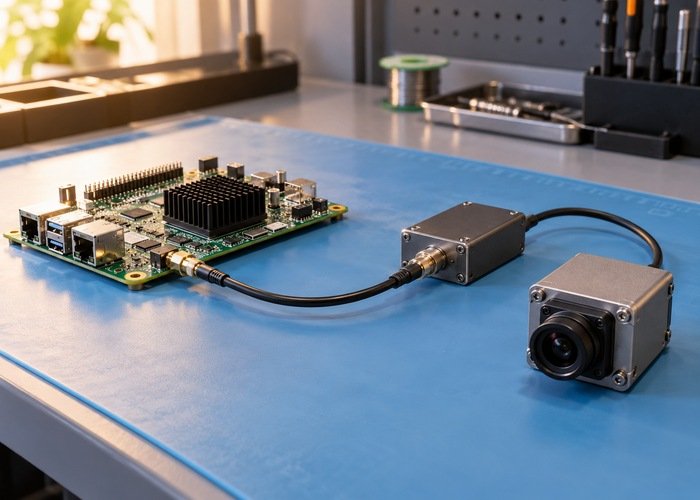
A GMSL camera is compatible with a Jetson system only when the complete hardware and software combination is supported: camera sensor and serializer, deserializer board, carrier routing, Jetson module, BSP release, driver, device tree, and intended capture API. A matching connector or the phrase “Jetson compatible” is not enough evidence for an order.
Ask for a tested combination identified by part numbers and revisions, plus a reproducible capture procedure for your intended image mode. If the supplier cannot identify the carrier and software image used, treat support as unconfirmed. Separate a documented ready-to-test combination from a project that still requires driver or board adaptation.
The GMSL camera category is a starting point for a hardware shortlist. Before selecting a sample, attach the compatibility worksheet below to the inquiry. Product availability and system-level compatibility are different questions, and the latter needs evidence for the exact integration.
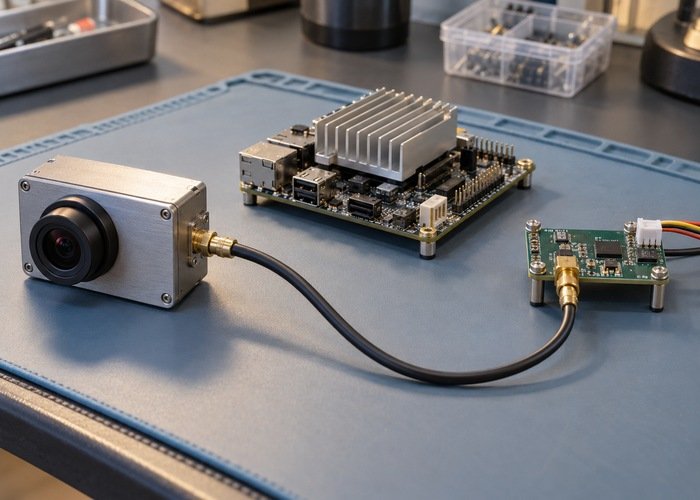
Identify the module, carrier, and camera chain
List the Jetson module part number, carrier manufacturer, board revision, camera sensor, serializer, deserializer, connector, and cable assembly. Include the power arrangement and any adapter board. Two systems described with the same Jetson family name can have different camera interfaces and board support requirements.
The NVIDIA Orin NX and Nano adaptation guide distinguishes the module from its carrier and explains that a different carrier needs corresponding platform configuration. That versioned guide is evidence about board adaptation, not a guarantee that an arbitrary third-party carrier accepts every camera.
Compare the actual carrier-board options by their documented interfaces and supported images. Request the camera routing and support matrix for the selected revision. Do not infer deserializer support from another board that happens to use the same module.
Pin the software release before requesting a driver
Record JetPack, Jetson Linux, kernel, supplier BSP package, and camera-driver revisions as separate fields. Also identify the installation or flashing configuration and whether the package replaces a system image or adds components to an existing image. “Works on Linux” leaves too much unresolved for an embedded camera order.
The Jetson Linux r36.4.4 release notes provide a version-specific reference for platform and camera integration details. This article uses r36.4.4 documents as a concrete reference; it does not present that archive as the newest release or prescribe it for every module.
Use the NVIDIA documentation index to locate the guide for the target image. An example from another release can use a different framework or packaging method. Ask the supplier which versions it actually tested and which upgrades require another validation run.
The driver and Jetson procurement checklist applies the same evidence principle to LiDAR. For cameras, keep the imaging path explicit as well: the application may depend on functions beyond basic transport or device enumeration.
Check the serializer-to-capture path
NVIDIA’s r36.4.4 GMSL framework guide describes a reference arrangement using serializer/deserializer devices, camera drivers, and device-tree configuration. Its reference hardware is an implementation example, not a universal interchangeability list for all GMSL modules.
Ask whether the supported chain matches your sensor and SerDes parts, link arrangement, CSI routing, and camera modes. For multiple cameras, request the virtual-channel mapping and simultaneous-capture evidence. A single successful stream does not establish that all intended streams can run together under the selected topology.
Also request the allowed cable and power arrangement. Follow the equipment’s connection procedure, including power-down requirements where specified. A connector that fits mechanically does not establish pin assignment, power compatibility, or a validated link configuration.
| Compatibility field | Evidence to request | What remains uncertain without it |
|---|---|---|
| Module and carrier revision | Exact tested part numbers and board image | Whether the platform routing and configuration match |
| Sensor and SerDes chain | Part identities and supported topology | Whether the driver controls the actual devices |
| Software baseline | JetPack, Jetson Linux, kernel, BSP and driver revisions | Whether installation is reproducible |
| Image modes | Resolution, rate, pixel format and camera count tested | Whether the application’s mode is supported |
| Capture API | Working command or application and output | Whether transport success reaches the intended consumer |
| Support boundary | Responsible party, known limitations and upgrade policy | Who handles a failed integration or release change |
Distinguish driver capture from application readiness
The NVIDIA camera software architecture guide distinguishes V4L2 access from the Argus and ISP paths. A raw capture working through one interface does not prove that the application’s intended processing path works. Identify whether the integration requires raw frames, processed images, or a particular supported API.
Ask for the pixel format and interpretation of the captured output. A file of plausible size is not enough; inspect that its format, dimensions, and content match the selected mode. Image processing and tuning can be additional work, especially when a Bayer sensor is expected to use a particular processing stack.
If the camera will join a robot perception system, separate software compatibility from timing and spatial calibration. The LiDAR–camera–IMU calibration workflow addresses those relationships. A compatible camera driver does not establish shared acquisition timing with the LiDAR.
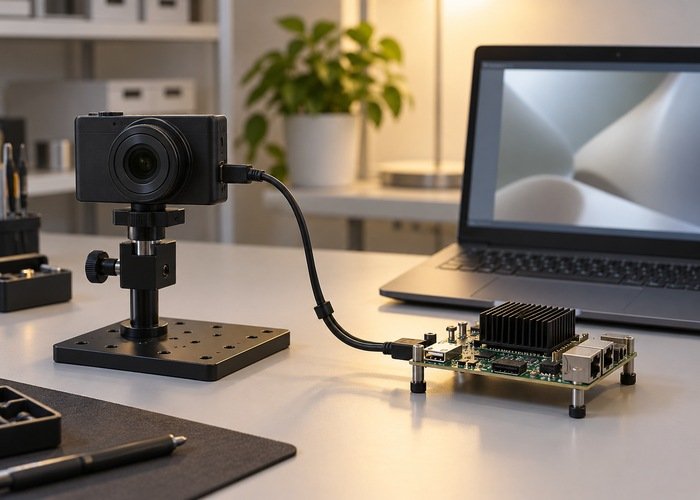
Request a bounded demonstration on the proposed combination
Ask for a short evidence package using the exact proposed module, carrier, camera, cable, and software baseline. It should include hardware identities, installation instructions, capture command, selected mode, output sample, and relevant logs. For simultaneous-camera use, request the intended camera count and channel arrangement rather than extrapolating from one connected device.
The sensor-driver programming guide describes V4L2 verification tools such as v4l2-compliance and v4l2-ctl. Have the supplier provide a mode-specific procedure for the supported package. Do not copy an example sensor’s resolution or pixel format into a different camera and call the resulting error a compatibility failure.
Agree on the test interval and pass criteria with the integration team. Retain capture behavior across a normal restart and application start/stop sequence where relevant. Record frame gaps, stream errors, and recovery behavior as observations; do not replace them with an unsupported claim of universal stability.
For sensor-fusion projects, use the robot sensor-fusion requirements guide to define the consuming application’s needs. The purchase decision should be based on evidence for that path, including timestamps and mode support, rather than the attractiveness of a preview image.
Classify the offer before placing an order
A documented combination has identifiable hardware, a pinned software package, an applicable capture procedure, and known limitations. A development offer instead includes adaptation work, a delivery boundary, and validation responsibilities. Both can be legitimate, but their schedule and engineering commitments differ.
Ask explicitly whether the quoted item includes a tested BSP image, driver source or supported binary package, device-tree configuration, installation support, and image-processing support where required. Keep unknown fields marked unknown. A supplier’s statement about a different developer kit is useful background, not acceptance evidence for your carrier.
Preserve the compatibility worksheet with the sample order and repeat its key tests before a batch purchase. If a later board revision, camera sensor, cable, or software release changes, reopen the corresponding evidence field. This makes the transition from sample success to a repeatable build easier to audit.
Frequently asked questions
Does “GMSL2” alone establish Jetson compatibility?
No. It identifies part of the transport context. The sensor, SerDes devices, board routing, software configuration, and capture path still need a supported combination.
Is a camera working on an AGX Orin developer kit proof for my carrier?
No. Ask for evidence on the proposed module and carrier revision. Board adaptation and camera routing can differ.
Does successful V4L2 capture prove Argus support?
No. Confirm the intended API and processing path separately, including mode and tuning requirements where applicable.
What should I send with a compatibility inquiry?
Exact module and carrier identities, target software release, camera count, image modes, capture API, cable arrangement, and the required demonstration or acceptance evidence.