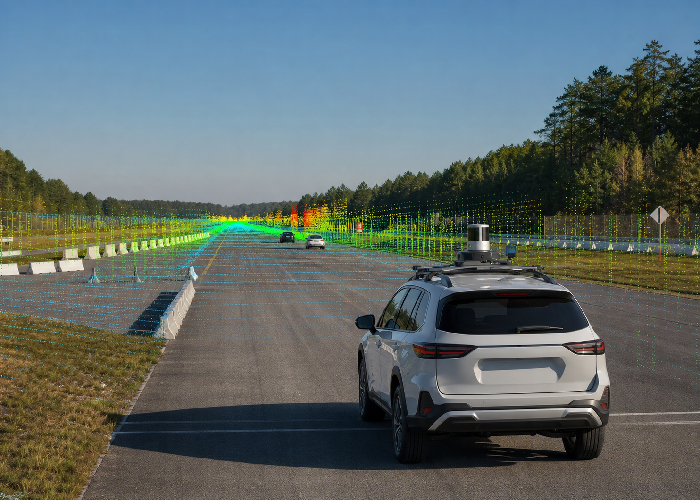
long-range 3D LiDAR sensor options are easiest to evaluate when the reader starts from the real work problem. Long-range 3D LiDAR sensors should be evaluated by the farthest distance at which the real application target is measured continuously and soon enough for software to act. A maximum-range specification does not capture target reflectivity, size, angle, point density, weather, motion or detection criteria. A defensible comparison uses surveyed targets, fixed pass conditions and the production mounting, computer and route.
The quick answer is that long-range 3D LiDAR sensors should be selected around the physical scene, not around a single maximum number. The sensor must cover the target, produce data the software can use, and support the response the machine needs to take.
For related internal planning, compare this requirement with autonomous-driving LiDAR applications, outdoor robotics LiDAR deployments, and the broader LidarStar long-range sensor catalog. These references keep the discussion tied to practical deployment choices.
Usable range versus maximum reported range: what to check
Maximum range can describe a favorable return without proving that the application target is detected reliably enough to support action. For long-range 3D LiDAR sensors, this question should be tied to a defined target, distance, viewpoint and decision. Otherwise, a technically correct measurement can still be irrelevant to the application.
Define target size, surface, orientation, weather, speed and minimum point count before measuring distance. Change one variable at a time, keep raw or minimally processed data, and record the exact configuration. The goal is a result another engineer can reproduce rather than a one-time demonstration.
Report the farthest repeatable application result, not the farthest isolated dot. Use NIST ranging tests for laser scanners as an independent reference while defining terminology, assumptions, or test evidence.
Target reflectivity size angle and point density: what to check
Dark matte surfaces and grazing angles return less energy, while a small distant target may fall between beams. For long-range 3D LiDAR sensors, this question should be tied to a defined target, distance, viewpoint and decision. Otherwise, a technically correct measurement can still be irrelevant to the application.
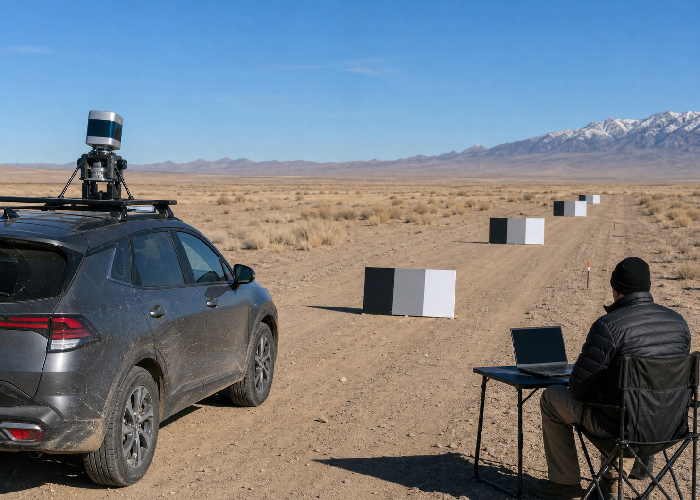
Place identical black, gray and white panels at surveyed distances and rotate them through realistic angles. Change one variable at a time, keep raw or minimally processed data, and record the exact configuration. The goal is a result another engineer can reproduce rather than a one-time demonstration.
Record valid points, range spread, frame-to-frame continuity and downstream detection for each condition. Use NIST laser scanner calibration experiments as an independent reference while defining terminology, assumptions, or test evidence.
| Decision area | Practical question | Evidence to save |
|---|---|---|
| Coverage | Does the field of view include the real target? | Photos, scan captures, and route notes |
| Timing | Can the controller act soon enough? | Timestamps and behavior logs |
| Environment | Do lighting, dust, vibration, or surfaces change results? | Difficult-scene examples |
| Integration | Can software use the output directly? | Driver, frame, and message checks |
| Maintenance | Can the site keep it aligned and clean? | Service access review |
Angular resolution field of view and detection continuity: what to check
Angular spacing determines how rapidly points spread apart with distance and whether a target keeps enough samples for classification or tracking. For long-range 3D LiDAR sensors, this question should be tied to a defined target, distance, viewpoint and decision. Otherwise, a technically correct measurement can still be irrelevant to the application.
Use poles, people-sized forms and vehicles across the horizontal and vertical field of view. Change one variable at a time, keep raw or minimally processed data, and record the exact configuration. The goal is a result another engineer can reproduce rather than a one-time demonstration.
Save the distance where geometry becomes unstable rather than relying only on a central target. Use FDA laser product safety information as an independent reference while defining terminology, assumptions, or test evidence.
Sun rain fog dust and window condition: what to check
Sunlight, precipitation, airborne particles and a contaminated optical window can reduce margin or create unwanted returns. For long-range 3D LiDAR sensors, this question should be tied to a defined target, distance, viewpoint and decision. Otherwise, a technically correct measurement can still be irrelevant to the application.
Repeat the same course in clear, wet, low-sun and spray conditions with documented window state. Change one variable at a time, keep raw or minimally processed data, and record the exact configuration. The goal is a result another engineer can reproduce rather than a one-time demonstration.
Define degraded-mode behavior when confidence falls below the operational threshold. Use NOAA LiDAR measurement overview as an independent reference while defining terminology, assumptions, or test evidence.
Timing motion distortion calibration and compute: what to check
Vehicle motion and poor time alignment can smear distant structure, while calibration errors produce larger spatial offsets at range. For long-range 3D LiDAR sensors, this question should be tied to a defined target, distance, viewpoint and decision. Otherwise, a technically correct measurement can still be irrelevant to the application.
Drive the production route at several speeds and compare fixed landmarks against surveyed references. Change one variable at a time, keep raw or minimally processed data, and record the exact configuration. The goal is a result another engineer can reproduce rather than a one-time demonstration.
Measure end-to-end latency and preserve raw data so geometry and processing errors can be separated. Use NIST reflectivity and laser scanner measurement research as an independent reference while defining terminology, assumptions, or test evidence.
A surveyed long-range acceptance course: what to check
A useful long-range course includes known distances, difficult surfaces, lateral positions, moving targets and environmental variation. For long-range 3D LiDAR sensors, this question should be tied to a defined target, distance, viewpoint and decision. Otherwise, a technically correct measurement can still be irrelevant to the application.
Run repeated approaches and crossings with a synchronized ground-truth reference. Change one variable at a time, keep raw or minimally processed data, and record the exact configuration. The goal is a result another engineer can reproduce rather than a one-time demonstration.
Approve the sensor only when the machine response remains timely and repeatable at the required operating boundary. Invite operators and maintenance staff to review the result because they see workflow and service conditions that a bench test misses.
A field scenario that exposes the weak point
Imagine the first pilot for long-range 3D LiDAR sensors looks convincing during a calm demonstration. The expected target is visible, the visualization is clean, and the operator sees the intended event. The scene changes during normal work: dark matte surfaces and grazing angles return less energy, while a small distant target may fall between beams. At the same time, mounting, timing, background conditions, or processing removes some of the margin that existed during the demonstration. The system still produces data, but the decision arrives late, becomes unstable, or creates an unnecessary alert.
The useful response is not to change several filters at once. Recreate the difficult scene at reduced operational risk, preserve the original configuration, and follow this test: Place identical black, gray and white panels at surveyed distances and rotate them through realistic angles. Then repeat with one controlled change and compare raw measurements, interpreted output, and final behavior on the same timeline. This reveals whether the limiting step is sensing, geometry, software, integration, or the acceptance rule itself.
Close the investigation with an operator-visible criterion. Record valid points, range spread, frame-to-frame continuity and downstream detection for each condition. Record the target, distance, direction, environmental state, software version, first reliable detection, and the action that followed. Keep one failed run beside the passing run. That pair is more useful for future maintenance than a polished final screenshot because it shows exactly which boundary the installation must continue to respect.
Pilot evidence before selection
For a later-stage project review, compare the article guidance with LiDAR sensor product families, then keep the measurement assumptions close to neutral LiDAR technology overview and NIST laser scanner ranging tests. This keeps How to Evaluate Long-Range 3D LiDAR Sensors tied to repeatable evidence rather than a single attractive demonstration.
When the application involves robots, vehicles, or moving equipment, review robotics LiDAR applications and OSHA robotics safety overview together. For teams using ROS data, ROS 2 LaserScan message definition and ROS PointCloud2 message definition are useful references for checking whether the output format matches the software contract.
Before the final shortlist, compare the physical environment against industrial automation LiDAR deployments. If timing, frames, or collision behavior matter, save notes beside ROS 2 tf2 transform documentation and Nav2 collision monitor documentation so another engineer can repeat the same check later.
For purchasing or scaling decisions, connect the final requirement back to request a LiDAR application recommendation. Safety, compliance, and training notes can be checked against ISO 3691-4 driverless industrial truck safety standard, while the supporting video reference related LiDAR application video gives the team a quick visual reminder of practical LiDAR behavior.
For outdoor, public, or high-reflectivity scenes, keep NIST laser scanner calibration experiments, NOAA LiDAR measurement overview, and FDA laser product safety information with the project notes. Those references help the next reviewer understand calibration, measurement context, and laser-safety assumptions.
A pilot for long-range 3D LiDAR sensors should be written like an engineering record. Record the test location, sensor height, mounting angle, route or scene boundary, object size, lighting, surface condition, software version, and the exact behavior expected from the system. The notes should be factual enough that another engineer can repeat the test without guessing what the first team meant.
Collect three layers of evidence. The first layer is raw or minimally processed sensor data. The second layer is the interpreted result, such as an object, track, zone event, depth map, or filtered cloud. The third layer is the actual behavior that followed, such as a stop, warning, route update, measurement, or message. When those layers are saved together, the team can identify whether a problem came from sensing, processing, or decision logic.
Start with a calm baseline, then add ordinary difficulty one variable at a time. Run the same scene with a normal target, a dark target, an angled target, a small target, and a partially hidden target. If the system changes behavior, the team can see which condition caused the change. This slower rhythm usually saves time because it avoids a confusing pile of uncontrolled test results.
The pilot should also include a negative case that should not trigger action. That may be an object outside the route, a person standing in a safe area, a pallet behind a boundary, or motion that is moving away from the machine. Negative cases reveal whether the setup is selective or merely active. A dependable deployment needs both reliable detection and calm behavior when nothing important is happening.
Use real site timing. A sensor that looks stable while the machine is parked may not support the same behavior when a robot is turning, a conveyor is moving, or a vehicle is crossing the monitored zone. Save timestamps and controller responses, not only screenshots. Timing evidence is often what separates a promising demonstration from a system that can be trusted in daily work.
Common mistakes that hide weakness
The first mistake is testing only ideal scenes. Real deployments include dark objects, angled surfaces, temporary clutter, vibration, cleaning residue, glare, partial occlusion, and people working in unpredictable ways. Include the difficult cases early, because those cases decide whether the application can scale.
The second mistake is comparing a single headline number. Range, field of view, angular detail, frame rate, interface, environmental fit, output format, mounting, and support all matter. Their importance changes by application, so the comparison matrix should be built from the job rather than from a generic specification list.
The third mistake is deleting failure examples after the setup improves. Keep the missed object, false return, unstable track, delayed response, or poor mounting example. Those files explain why a later choice was made and help support staff recognize symptoms when the site changes. A clean final report without negative evidence is less useful than a practical record that shows the limits clearly.
The fourth mistake is reviewing only the engineering view. Operators know where people pause, where pallets are staged temporarily, which aisles become crowded, and which maintenance routines happen under time pressure. Their observations can change the sensor position, cable route, cleaning plan, or alert logic before the system becomes expensive to modify.
Another subtle mistake is ignoring the data contract. The receiving software must know the units, coordinate frame, timestamp behavior, confidence fields, and reset behavior. Clear data contracts prevent a good sensor from becoming an unreliable system because downstream code interpreted the output differently than the integration team expected.
Buying checklist
Before choosing hardware for long-range 3D LiDAR sensors, review the planned sensor position, required coverage, smallest target, dark-object behavior, required update timing, controller interface, environment, and service routine. If any item is unknown, run a small test before ordering hardware for multiple locations.
Ask for output examples in the format your software will use. A polished viewer is helpful for discussion, but the production system may need a scan topic, point cloud, object list, zone event, depth frame, or velocity field. Confirm driver availability, timestamp behavior, coordinate frames, configuration files, and recovery steps before treating the sensor as integration-ready.
Finally, review maintenance before purchase. The window must be reachable for cleaning, the bracket should resist vibration, the cable route should avoid strain, and the reset procedure should be clear to people who did not build the pilot. A technically strong sensor that is hard to maintain will lose reliability after installation.
Handoff notes for the next engineer
The handoff package for long-range 3D LiDAR sensors should include the final sensor position, mounting photos, cable route, host computer, interface settings, frame names, filter parameters, saved examples, and the reason important choices were made. It should also state the known limits plainly. The next engineer needs to know what was proven, what was rejected, and what still needs a longer trial.
Do not rely on memory for calibration or configuration. Save the files, screenshots, logs, and version notes beside the article or project record. If the sensor is moved, replaced, cleaned, or connected to a different controller, the team should have a repeatable check that confirms the system still sees the same targets in the same way.
A final readiness review should separate proven behavior from promising behavior. Proven behavior has repeated evidence under the expected scene conditions. Promising behavior has worked in a limited test but still needs more hours, weather, traffic, shifts, surfaces, or maintenance cycles. This distinction helps teams scale carefully without slowing down projects that already have enough evidence.
Write the acceptance test in plain language before the final run. State what target must be detected, where it will be placed, how fast the machine or object will move, what output is expected, and what response should follow. A pass should be observable by both the engineer and the site owner. If the pass condition cannot be written clearly, the project definition is not ready for a purchase decision.
Keep the acceptance test small enough to repeat after installation. A five-minute check that operators can run after cleaning, relocation, or software updates is often more valuable than a complex test that no one repeats. Repeatable checks protect the original sensor decision after the system leaves the pilot bench and make future maintenance decisions easier for every site team.
When the project is ready for a shortlist, review LidarStar long-distance perception solutions and share the site details through request a long-range LiDAR evaluation. A specific request produces a better recommendation than a broad sensor comparison.
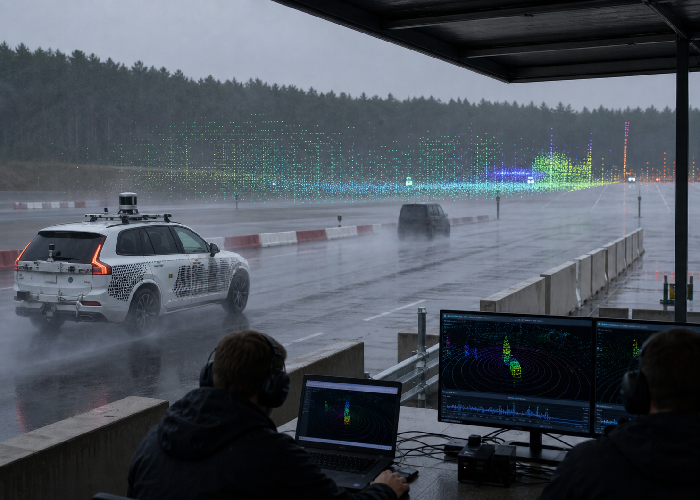
Before the final decision, repeat the most difficult long-range 3D LiDAR sensors test with the production mounting, production power supply, and production software configuration. A bench result is useful, but it does not include the vibration, cable routing, timing, contamination, or occlusion that appears on the finished machine.
Have someone who did not build the pilot run the short acceptance check. If that person cannot identify a pass, a failure, and the correct recovery step from the written instructions, the handoff is incomplete. This review catches assumptions that the original engineering team may no longer notice.
Record the final limits beside the successful results. State which target sizes, materials, angles, weather conditions, speeds, and mounting positions were tested, and which were not. Honest boundaries make future changes safer and give procurement a defensible basis for scaling the installation.
Conclusion
long-range 3D LiDAR sensors should be chosen from the job it must perform, the evidence it can produce, and the behavior the machine needs to take. Start with the real scene, test difficult objects, keep raw and processed data, and compare sensors against the deployment conditions. That approach turns long-range 3D LiDAR sensors from a promising specification into a practical engineering decision.
FAQ
What is the most important first step for long-range 3D LiDAR sensors?
Define the physical job and the decision the system must support before comparing specifications.
How should a team validate performance?
Use real objects, real mounting positions, real speed, and saved evidence from both successful and difficult runs.
Can one sensor solve every application?
No. The right choice depends on range, field of view, target size, environment, software output, and maintenance needs.
What information helps with sensor selection?
Scene photos, target dimensions, mounting limits, interface needs, environment notes, and expected machine behavior are the most useful details.
Why keep failed test examples?
Failure examples show limits clearly and prevent future teams from repeating the same mounting, filtering, or integration mistake.