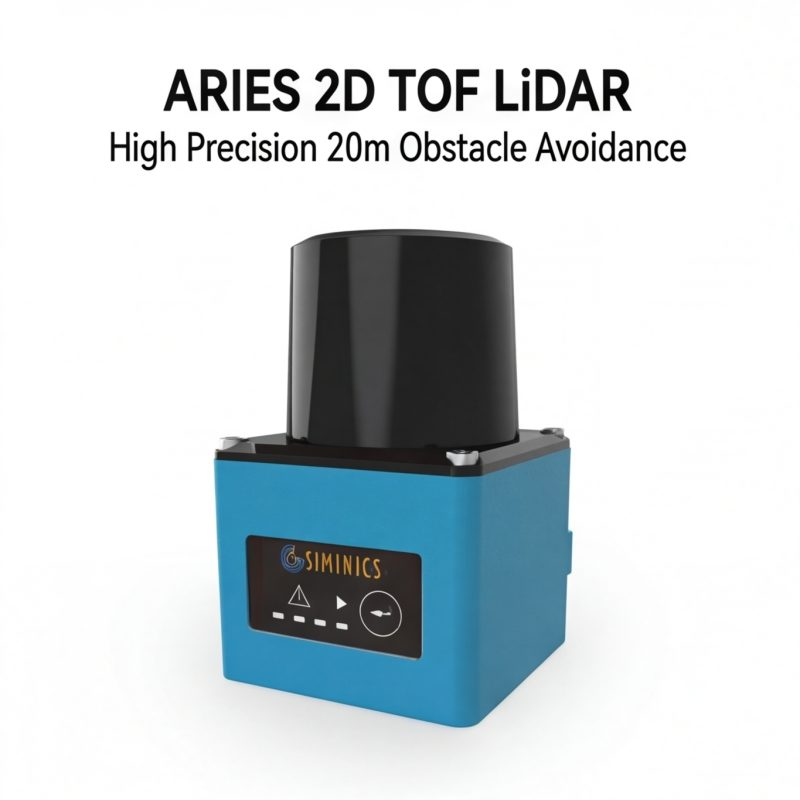
Autonomous systems relying on reactive detection alone are already obsolete — the industry’s next competitive line is drawn between sensors that detect and systems that predict.
LiDAR obstacle avoidance has crossed a threshold: stopping when something appears is no longer good enough.a
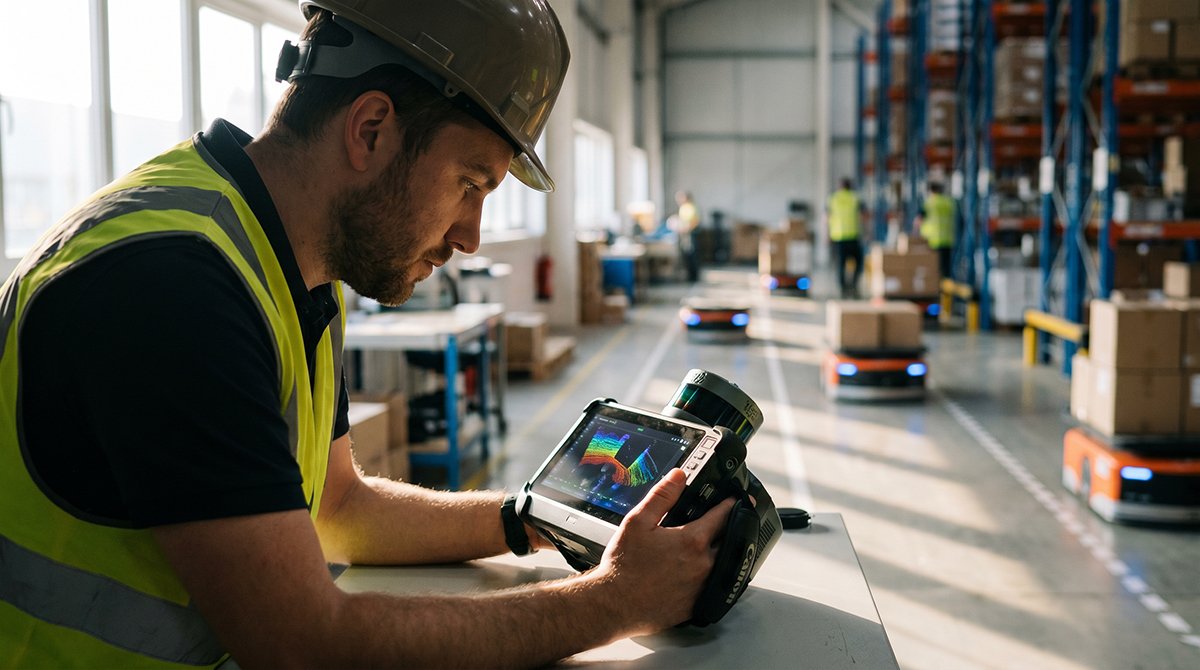
Traditional sensing technologies carry well-documented constraints. Ultrasonic sensors saturate at close range and perform poorly above 15 mph. 2D LiDAR flattens the world into a single horizontal plane, missing objects that crouch below or rise above its scan line — a crouching worker, a low-profile cart, a spilled pallet. In high-speed industrial and logistics environments, these blind spots aren’t inconveniences; they’re liability events waiting to happen.
Stop-on-detect logic compounds the problem. When a sensor flags any object in the path, the system halts — full stop — then waits for clearance. In a busy warehouse running automated mobile robots (AMRs) at throughput scale, those micro-stops accumulate. A single AMR triggering 30 unplanned stops per shift can bleed hours of productivity per week across a fleet. The bottleneck isn’t the hardware; it’s the decision architecture built around sensors that can’t distinguish a stationary shelf from a person walking across the lane.
This is precisely where 3D LiDAR redefines the baseline. As SAE International notes, “The integration of 3D LiDAR for obstacle detection is no longer optional for Level 4 autonomy; it provides the necessary redundancy that cameras and radar lack in low-light or high-glare conditions.” Cameras wash out in glare. Radar resolves shapes poorly. 3D LiDAR generates dense point clouds that hold up across lighting conditions and capture object geometry with enough fidelity to feed downstream classification models.
The capabilities enabled by that richer data signal the real frontier: path prediction. Instead of reacting to where an obstacle is, next-generation systems model where it’s going — and that shift demands an entirely different approach to processing 3D spatial data in real time. Understanding how systems track moving objects dynamically through that point cloud data is where the technical story gets genuinely interesting.
- Ultrasonic and 2D LiDAR fail to capture full object geometry in 3D space
- Stop-on-detect logic sacrifices operational efficiency at scale
- 3D LiDAR provides critical redundancy that cameras and radar cannot replicate
- Path prediction represents the next frontier beyond static obstacle detection
Dynamic Obstacle Detection and Tracking (DOT) in 3D Space
Effective lidar obstacle detection isn’t just about spotting objects — it’s about maintaining consistent, low-latency awareness of every moving actor across thousands of data points per second.
Processing point clouds for temporal consistency is the foundation of any DOT pipeline. A single LiDAR scan generates millions of discrete returns, but a single frame is nearly meaningless in isolation. What matters is how those returns change between scans. By comparing successive point clouds, the system builds a velocity estimate for each detected object — effectively tagging it as static infrastructure or a dynamic actor. A warehouse wall doesn’t move. A pedestrian or autonomous mobile robot does. According to research on deep-learning-based LiDAR detection, separating these categories reliably remains one of the harder open challenges in 3D perception.
High-resolution scanning directly determines whether small objects get detected at all. A low-density scan may ghost right over a misplaced toolbox or a crouched technician at close range. In manufacturing environments especially, the smallest obstacles often carry the highest injury risk. Sensors with tighter angular resolution and higher point density provide the granularity needed to classify objects that would otherwise appear as noise.
Latency is a non-negotiable constraint in real-time industrial tracking. A system that detects a fast-moving forklift but delivers that information 200 milliseconds late has already failed. In practice, detection-to-decision pipelines in active manufacturing cells need to operate under 50ms to be actionable. As noted in research from Fujipress / JACII, dynamic obstacle detection and tracking based on 3D LiDAR represents a critical capability gap in many entry-level autonomous systems today.
Key requirement: DOT systems must process temporal point-cloud deltas, classify actor types, maintain object IDs across frames, and deliver actionable data — all within strict cycle-time windows.
All of this — detection, classification, and tracking — feeds directly into the next challenge: understanding not just where an obstacle is, but where it’s going.
Path Prediction: Solving the ‘Intention’ Problem in Robotics
Knowing where an obstacle is tells you half the story — knowing where it’s going is what actually keeps autonomous systems safe.
The core challenge is intent estimation: a static snapshot of an