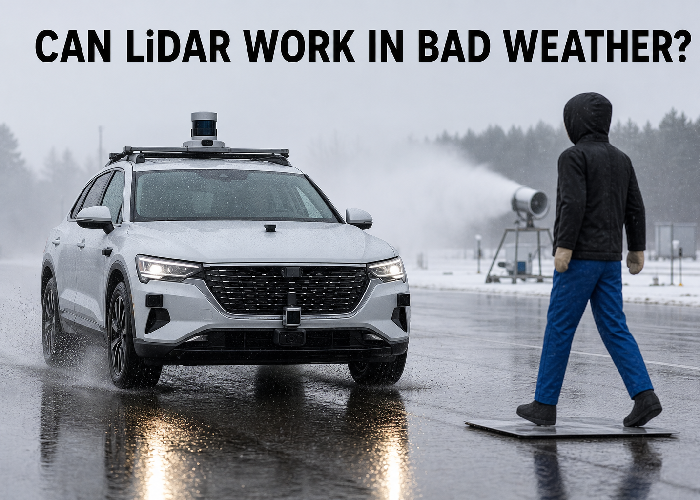
Automotive LiDAR in rain, fog and snow does not have a one-word pass or fail answer. Light rain may add sparse atmospheric returns while leaving a nearby vehicle clearly visible. Dense fog may reduce contrast and usable range far more sharply. Wet snow can both fill the air with returns and stick to the sensor window. The effect depends on visibility, precipitation rate, droplet or flake size, wind, target reflectivity, sensor position, cleaning and the perception stack.
The useful question is therefore not “Does LiDAR work in bad weather?” It is “Under which measured conditions does this sensor-and-software system still support the required driving function, and how does it recognize when it cannot?” That wording leads to a test plan rather than a marketing argument.
This guide uses a test-first approach for engineering and procurement teams. It separates airborne weather from window contamination, explains what to log, and turns raw point-cloud degradation into decision-level acceptance criteria for autonomous vehicle perception.
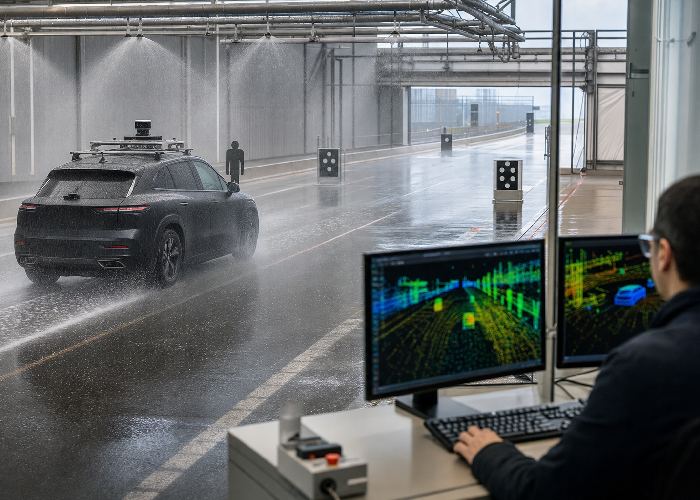
Three different problems are often called weather
The first problem is propagation through the air. Rain drops, fog droplets and snowflakes can scatter or attenuate emitted light, reducing target returns and creating points between the sensor and the object. Fog is especially important because many small droplets can occupy the beam path continuously. The NOAA visibility sensor guide explains the broader relationship between particles, light scattering and measured visibility.
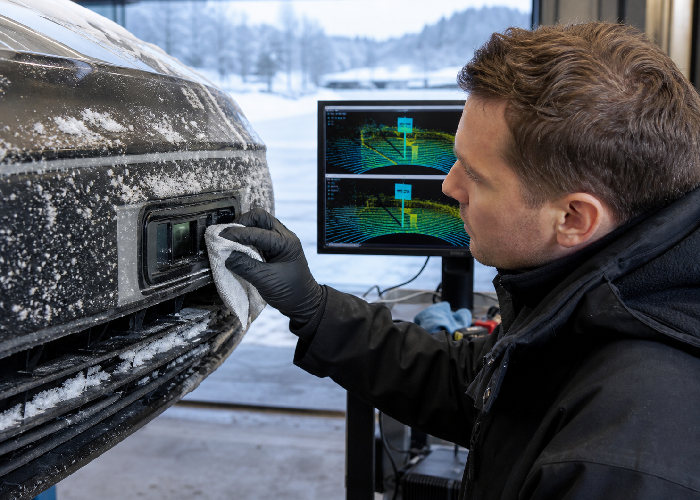
The second problem is contamination on the optical window. A water film, salt spray, mud, ice or packed snow sits close to the transmitter and receiver and can block or distort a large portion of the field of view. Two drives in the same rain can produce different results if one sensor sits in clean airflow while another collects road spray from the vehicle ahead.
The third problem is the perception response. Raw points may become sparser or noisier, but the software decides whether a target is tracked, whether free space is trusted, and whether the vehicle slows down. Weather testing must therefore preserve raw data, intermediate detections and final behavior. Otherwise, teams may blame the sensor for a filtering error or praise the sensor while the object tracker quietly fails.
Rain: measure rate, spray and wet-window state separately
Rain introduces droplets across the beam path, but ordinary rain and dense road spray are not identical. A controlled spray bar can produce a repeatable precipitation zone, while a lead vehicle on wet pavement creates directional plumes and dirty aerosol. Test both if the operating design domain includes them. Record precipitation rate, vehicle speed, wind and target distance instead of writing only “heavy rain” in the log.
Begin with a clean, dry baseline. Repeat with airborne rain while keeping the sensor window clean, then deliberately introduce a documented wet-window condition. This separates transmission loss in the atmosphere from near-field blockage. If the system has a washer, wiper, air knife or heater, record activation timing and recovery time rather than merely confirming that the hardware exists.
The Federal Motor Carrier Safety Administration sensor-performance project notes that dirt, rain, snow, insects and object strikes can affect externally mounted automation sensors and highlights cleanliness and secure mounting. That maintenance view is important: adverse-weather reliability includes the ability to restore a clear aperture during a shift, not only the ability to survive a laboratory shower.
Fog: visibility is the test condition
Fog can attenuate the path and produce backscatter throughout the measured volume. Do not define a test by whether the chamber “looks foggy.” Use a visibility or extinction measurement and keep it with the run. A target that remains visible at 30 metres in one fog distribution may disappear much sooner in another even when both scenes look similar to a camera.
Use targets at several ranges and reflectivities, including a dark target. Measure valid-return rate, range bias, intensity distribution where meaningful, atmospheric point density and first-detection distance. Repeat as visibility decreases in controlled steps. The system should show a gradual, explainable degradation or declare a fault; sudden unreported confidence is a more dangerous result than an honest reduction in range.
A published NHTSA-hosted adverse-weather reliability study describes weather performance as an emerging measurement problem and summarizes work using controlled chambers and natural events. One useful lesson is that raw sensor behavior and the full driving function are different levels of evidence. A point cloud can degrade without immediate feature failure, while a perception algorithm can fail even when some target points remain.
Snow: airborne flakes and accumulation need different tests
Falling snow creates transient returns and can reduce target visibility, but accumulation may dominate over time. Dry powder, wet snow and blowing snow behave differently. A short run through falling snow does not validate a two-hour drive where slush repeatedly reaches the sensor face. Build separate tests for airborne snow, road spray and parked accumulation.
Check whether the heater prevents ice under the expected temperature, airflow and power conditions. A heater can keep the center clear while the edge remains blocked, altering only part of the field of view. Inspect the point cloud by azimuth and elevation so a regional blind area is not hidden inside an overall point count.
After cleaning, verify that the system truly recovers. A washer may leave a thin film, and a wiper may drag salt across the window. Save before, during and after data against the same fixed targets. Recovery time should be measured from contamination to restored task performance, not from button press to the end of a cleaning cycle.
| Condition | Primary mechanism | Useful measurements |
|---|---|---|
| Rain aloft | Scattering and attenuation | Return rate, false points, range stability |
| Road spray | Dense droplets plus contamination | Window state, recovery time, track continuity |
| Fog | Distributed small-droplet scattering | Visibility, usable range, confidence |
| Falling snow | Transient flakes and attenuation | Regional density and false detections |
| Wet snow/ice | Partial or full aperture blockage | Blocked field of view and heater recovery |
| Salt/mud film | Persistent optical loss | Cleaning effectiveness and diagnostics |
Target choice determines whether the result is useful
Use targets that represent the driving task: a vehicle rear, a dark vehicle side, a soft pedestrian target, a tire, a lane-side barrier and smaller debris where relevant. Place them at distances tied to the function’s speed and stopping strategy. A bright board at ten metres can confirm that the sensor is alive, but it cannot prove reliable detection of a low-reflectivity object at the planning horizon.
Keep target pose fixed between weather stages and survey its distance. For moving-target tests, use a controlled path and synchronize ground truth. Repeat enough runs to see variability. Weather is stochastic; one successful pass can be luck, and one failed point can be an isolated droplet. Report distributions and failure frequency, not only the cleanest screenshot.
When comparing automotive LiDAR sensor options, ask which target reflectivity, visibility, precipitation rate and window condition support each claim. A range number without environmental context does not tell a test engineer where the system’s confidence boundary lies.
Log data at three layers
Layer one is raw sensing: packets or point clouds, intensity or reflectivity fields where available, timestamps, diagnostics and window-status signals. Layer two is perception: filtered cloud, free-space estimate, detections, tracks and confidence. Layer three is behavior: warnings, fallback state, requested deceleration, actual vehicle response and minimum target clearance.
Synchronize those layers with weather instrumentation, vehicle speed and cleaning commands. When a target track disappears, the timeline should reveal whether raw returns weakened first, a filter rejected them, the tracker timed out, or the aperture became blocked. This is the difference between a useful failure report and a video that only shows the vehicle stopping late.
The related research video below discusses semantic segmentation of LiDAR point clouds in adverse weather. It is a useful reminder that perception quality and labeling strategy matter alongside hardware, but a production decision still needs validation on the intended sensor, targets and conditions.
Metrics that reveal more than average range
Measure probability of detection at defined ranges, but also track first-detection distance and continuity. A target detected once and lost for the next ten frames may not support stable planning. Record false positive density by region, range error on fixed targets, point count on target, track age, confidence and time to system degradation warning.
For contamination, divide the field of view into sectors. A partially blocked window may leave the overall point count high while removing the exact region needed for a turn or merge. Sector diagnostics should connect to a fallback strategy. If the system cannot verify a required region, it should not continue behaving as though full perception is available.
Include recovery metrics: cleaning request to clear-window confirmation, clear-window confirmation to restored detection, and the number of cycles before manual service is needed. These numbers affect route planning and maintenance more directly than a single weather chamber range.
Sensor fusion should express disagreement
Radar, cameras and LiDAR respond differently to lighting, particles, target material and contamination. Fusion can improve resilience because failures are not identical, but only if the software represents confidence and disagreement. A fused object should not remain highly trusted merely because one stale source continues to publish.
Test each modality alone in the same conditions, then test fusion. Inject regional LiDAR blockage, camera glare and degraded radar returns where safe and appropriate. Verify which source supports each track and how the planner reacts when evidence conflicts. The Federal Transit Administration automation research report provides a broad public-sector view of sensing limitations and the use of multiple sensing approaches in automated vehicles.
Avoid declaring one modality the winner. The engineering target is a system whose limitations are observable and whose response remains appropriate. That may mean reduced speed, greater following distance, a minimal-risk maneuver or a handoff, depending on the vehicle and operating design domain.
A proving-ground scenario
Consider a low-speed autonomous shuttle validated first in dry weather. In controlled rain, the roof LiDAR retains the soft vehicle target, but a lower front sensor accumulates spray and loses the right-front sector after several passes. The fused system continues because the global point count remains above its threshold. The problem is not that LiDAR cannot work in rain; the problem is that diagnostics describe total activity instead of required regional coverage.
The team adds sector-level health monitoring and a repeatable spray run behind a lead vehicle. It records the time from the first blocked rays to the cleaning request and from cleaning to restored track continuity. The washer clears clean water quickly but struggles after a salt mixture, so the maintenance interval and fluid strategy become part of the design.
Next, a fog stage shows a gradual reduction in first-detection distance. The controller’s fixed speed leaves too little planning margin before any formal fault is raised. A visibility-aware operating rule lowers speed before the track becomes unstable. The final acceptance case now connects measured weather, sensor evidence, diagnostics and behavior.
Design a weather validation matrix
Build the matrix from the operating design domain. Rows should include rain rate, visibility, snow type, temperature, wind, road spray and contamination state. Columns should include target, range, relative speed, approach angle, sensor cleaning state and required behavior. Mark which combinations are safety-critical, which are exploratory and which are outside operation.
Run clean-weather controls at the start and end of each session. A changed baseline may indicate sensor movement, temperature drift, window damage or software configuration changes. Preserve configuration hashes and firmware versions. Without a stable baseline, an apparent weather effect may actually be a different filter or mounting position.
For application-specific planning, connect the matrix to LiDAR perception solutions and share target, speed, weather and interface requirements through the automotive LiDAR project form. A useful recommendation needs the failure consequences and maintenance strategy, not just the desired maximum range.
Procurement questions worth asking
Ask how the sensor reports blockage, degradation and thermal state. Confirm environmental ratings, but do not treat an enclosure rating as proof of perception performance in precipitation. Ask about window coatings, heater power, cleaning compatibility, mounting airflow, diagnostic granularity and the data available to the vehicle controller.
Request adverse-weather test conditions and target definitions behind published results. Look for visibility, precipitation rate, target reflectivity, range, speed and cleaning state. Confirm whether the reported metric is raw detection, object tracking or a complete driving function. These are different claims and should not be mixed.
Finally, review laser classification, installation and service procedures. Neutral background such as the LiDAR technology overview can help non-specialists understand the sensing principle, but supplier documentation and the vehicle’s risk process must govern the actual installation.
Confirm chamber results in natural weather
Controlled chambers are valuable because conditions can be repeated, but natural weather adds wind shifts, mixed droplet sizes, dirty spray, changing backgrounds and long exposure. After chamber testing establishes the failure boundary, run a limited proving-ground campaign in measured natural rain, fog or snow. Keep the same reference targets and log format so the two datasets can be compared instead of becoming separate demonstrations.
Natural-weather runs should not expand the operating domain casually. Use them to challenge assumptions from the controlled test: whether contamination builds faster, whether cleaning works while moving, and whether changing road reflectance affects free-space processing. When results disagree, investigate the missing variable and update the matrix. The objective is a test description that another team can reproduce, not a claim that one dramatic storm represented every adverse condition.
FAQ
Does rain stop automotive LiDAR from working?
Not automatically. Performance depends on rain rate, road spray, target, range, sensor design, window state and processing. Controlled testing should measure both airborne effects and contamination.
Why can fog be more difficult than ordinary rain?
Fog contains many small droplets distributed through the path, which can scatter and attenuate light continuously. Use measured visibility rather than a visual label to define the test.
Is an environmental enclosure rating enough?
No. It describes resistance to environmental ingress under defined tests, not object-detection performance through precipitation or a contaminated optical window.
What is the most important weather metric?
There is no single metric. Combine measured weather, target detection and continuity, regional field-of-view health, false returns, diagnostics and task-level response.
How should a cleaning system be evaluated?
Test representative water, salt, mud, snow and ice states; measure activation and recovery time; and confirm that the required field of view and object tracking actually return.
Can sensor fusion solve every weather problem?
No. Fusion improves resilience when modalities fail differently, but it must model confidence, stale data and disagreement. Each sensor and the combined behavior still require validation.
Conclusion
For a later-stage project review, compare the article guidance with LiDAR sensor product families, then keep the measurement assumptions close to neutral LiDAR technology overview and NIST laser scanner ranging tests. This keeps Can Automotive LiDAR Work in Rain, Fog and Snow? A Test-First Answer tied to repeatable evidence rather than a single attractive demonstration.
When the application involves robots, vehicles, or moving equipment, review robotics LiDAR applications and OSHA robotics safety overview together. For teams using ROS data, ROS 2 LaserScan message definition and ROS PointCloud2 message definition are useful references for checking whether the output format matches the software contract.
Before the final shortlist, compare the physical environment against industrial automation LiDAR deployments. If timing, frames, or collision behavior matter, save notes beside ROS 2 tf2 transform documentation and Nav2 collision monitor documentation so another engineer can repeat the same check later.
For purchasing or scaling decisions, connect the final requirement back to request a LiDAR application recommendation. Safety, compliance, and training notes can be checked against ISO 3691-4 driverless industrial truck safety standard, while the supporting video reference related LiDAR application video gives the team a quick visual reminder of practical LiDAR behavior.
For outdoor, public, or high-reflectivity scenes, keep NIST laser scanner calibration experiments, NOAA LiDAR measurement overview, and FDA laser product safety information with the project notes. Those references help the next reviewer understand calibration, measurement context, and laser-safety assumptions.
Automotive LiDAR in rain, fog and snow should be judged by measured conditions and vehicle behavior, not by a universal yes or no. Separate atmospheric scattering from window contamination, test real targets, log raw sensing through final control, and verify degradation detection and recovery. A system is ready when it knows what it can still see, what it cannot, and how the vehicle must respond.