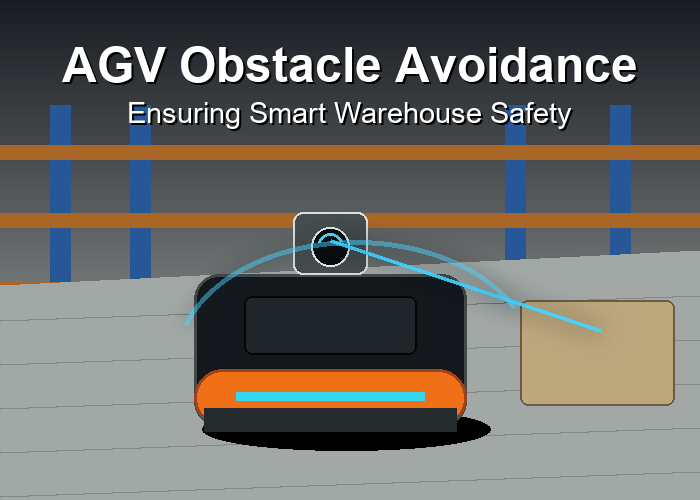
An AGV obstacle avoidance LiDAR sensor should be selected around the route, the payload, and the objects that appear during real work. A clean demo aisle can make almost any robot look smooth. A working warehouse is different. Pallets sit slightly outside their lanes, cartons fall near the floor, stretch wrap hangs from loads, and people cross the aisle while thinking about their own task.
Start with the question that decides everything: what must the AGV notice early enough to slow down, stop, or reroute without disrupting the warehouse team?
Quick Answer: Test The Route, Not Just The Sensor
Obstacle avoidance is not only a detection feature. It is a behavior. The sensor may detect a pallet corner correctly, but if the AGV stops too late, stops too sharply, or stops too often, the workflow still suffers. The right sensor choice is the one that supports predictable movement in the actual aisle.
The industrial automation LiDAR page is a useful internal starting point because AGV sensing must connect to production flow, material movement, and maintenance. The robotics LiDAR application page is helpful when the project also involves mapping or autonomous navigation.
Map The Three Places Where AGVs Usually Struggle
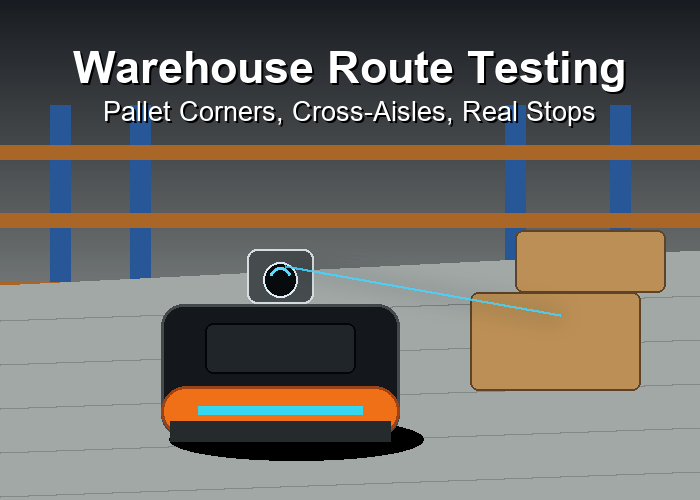
Most AGV sensing problems appear in three places: turns, cross-aisles, and docking or handoff points. Turns are difficult because the robot body, payload, and route boundary all change position at once. Cross-aisles are difficult because other movement enters the route from the side. Docking is difficult because small alignment errors can create repeated stops or physical contact.
Walk those three areas before choosing hardware. Measure the narrowest aisle, note the typical pallet position, and look at where a worker would naturally stand. The route walk should include ordinary clutter, not only a cleaned-up demonstration space.
For broader context, the overview of autonomous mobile robots helps explain how mobile platforms sense and move through changing spaces. The general LiDAR overview is useful for buyers who need a simple explanation of distance sensing.
| AGV scene | What to test | Why it matters |
|---|---|---|
| Pallet corner | Detection before turning | Prevents side impact |
| Cross-aisle | Person or cart entering route | Supports smooth slowdown |
| Docking station | Repeatable approach | Reduces alignment faults |
| Low carton | Scan height and contrast | Catches floor-level objects |
| Loaded AGV | Payload blocking view | Prevents hidden blind spots |
Mounting Height Decides What The AGV Really Sees
A 2D LiDAR sensor reads a scan plane. If that plane misses the object, the software cannot recover the missing information. Mount too high and the AGV may miss low cartons or pallet edges. Mount too low and the sensor may react to floor details, dust, or harmless threshold strips.
The best mounting height is found by testing real objects. Put a pallet corner, low carton, dark tote, rack leg, and parked manual cart in the route. Move each object slightly between trials. This shows whether the sensor is stable across normal warehouse variation.
NIST work on mobile robotics systems and standard test methods is a useful external reference because it encourages repeatable performance testing rather than one polished demonstration.
Design Slowdown Zones Before Rollout
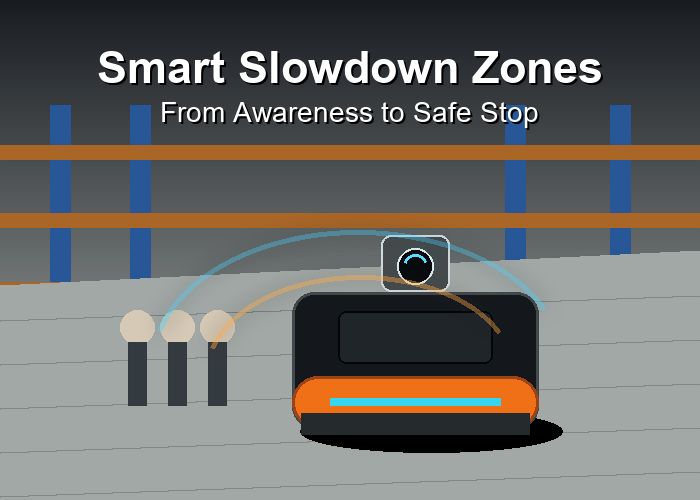
One large stop zone usually makes AGV behavior feel rough. A better approach is to separate awareness, slowdown, and stop zones. The outer zone prepares the robot. The middle zone creates a smoother speed change. The near zone handles immediate risk. A known ignore zone can remove the robot body or fixed structure from the scan.
These zones should be tied to the operating speed and load. A light AGV moving slowly through a controlled aisle needs a different response from a loaded unit approaching a busy cross-aisle. If the zone design ignores speed and payload, even a strong sensor may feel poorly tuned.
The OSHA warehousing safety overview is a useful reminder that mobile equipment, material handling, and pedestrians must be managed together. LiDAR is one sensing layer inside a broader workflow.
How To Reduce Nuisance Stops
Nuisance stops often come from expected structure inside a broad detection zone. Rack legs, floor tape, dock edges, and the AGV body itself can trigger repeated alerts if the system is not tuned. Each false stop should be labeled with a cause: reflection, known structure, object angle, payload blockage, or sensor vibration.
Once the cause is known, the fix becomes more practical. Reflection may need a different angle or filtering. Payload blockage may need a different mount. Known structure may need an ignore zone. Vibration may need a stiffer bracket. A different sensor is not always the first answer.
When To Consider Another LiDAR Layer
A 2D sensor is strong for planar route awareness. If the AGV must understand load height, overhanging objects, or more complex shapes, compare the project with 3D LiDAR sensor options or Flash LiDAR sensors for specific parts of the task.
How To Turn A Route Into Sensor Requirements
A useful sensor requirement is not a slogan such as better safety or smoother navigation. It is a short description of what the robot must notice, where it must notice it, and what the robot should do next. For example, the system may need to detect a low box before a turn, slow near a crossing person, or align with a docking face without repeated small corrections.
Write the requirement in the language of the route. Include the object, the distance, the movement, and the response. This makes the discussion practical for engineering, operations, and purchasing. It also prevents the team from choosing a sensor only because a headline range or scan angle looks attractive.
The easiest way to build the requirement is to walk the route and pause at every decision point. Ask what can enter the robot path, what the robot body may block, where the floor or lighting changes, and where people expect the robot to behave politely. Those answers become the first version of the test plan.
Installation Details That Change The Result
Small installation choices often matter more than people expect. A sensor mounted a few centimeters higher may miss low objects. A sensor mounted too far back may see the robot body. A bracket that vibrates can make readings unstable. A cable that is hard to service can turn a good prototype into a frustrating fleet installation.
Before finalizing the mount, check four things: view, protection, cleaning access, and service access. The sensor needs a clear view of the target zone. It also needs protection from bumps, dust, carts, and routine cleaning. A technician should be able to inspect the sensor window and replace the unit without dismantling the robot.
If the robot has a payload tray, lift mast, decorative shell, or front bumper, test with that equipment installed. A bare test platform can give a false sense of confidence. The final robot body is part of the sensing scene.
A Short Field Test Is Better Than A Long Guess
Run the planned route slowly first, then at the intended operating speed. Place the most common objects in realistic positions instead of neat demo positions. Keep notes on what the sensor sees, what the software does with the data, and whether the movement response feels natural.
The best early test is not designed to make the sensor look perfect. It is designed to reveal where the installation is strong and where it needs adjustment. That may mean changing mounting height, narrowing a zone, moving a bracket, or using a different sensing layer for one part of the route.
A good field test should include at least one clean run, one cluttered run, one human-crossing run, one docking or handoff run, and one run with the robot carrying its normal payload. If the route works only when it is clean and empty, the project is not ready for daily operation.
| Test step | What to observe | Decision it supports |
|---|---|---|
| Clean route | Baseline movement and sensor stability | Confirms basic setup |
| Cluttered route | Boxes, pallets, bags, or carts | Checks real obstacle handling |
| Human crossing | Natural walking speed | Tunes slowdown behavior |
| Docking or handoff | Final approach consistency | Tests close-range control |
| Loaded robot | Payload blockage and braking | Validates operating condition |
How To Review False Alerts
False alerts should be treated as clues, not just annoyances. A false stop may show that the scan plane is crossing a known fixture. It may show that the response zone is too wide. It may reveal reflection from a floor or a shiny surface. It may also show that the robot body or payload is entering the sensor view.
Label each false alert with a likely cause. Do not simply write failed. Write floor reflection, rack leg inside zone, payload blockage, crossing object too close to normal structure, or bracket vibration. This makes the next action clear. The fix may be a software rule, a mounting change, a cleaning change, or a different sensor layer.
The goal is not to remove every alert. The goal is to make alerts meaningful enough that operators trust the robot. If the robot reacts to harmless details all day, people will work around it instead of with it.
How To Decide Whether The Pilot Is Ready To Scale
A pilot is ready to scale when the route behavior is repeatable, maintenance is realistic, and the team can explain the remaining limits. It does not need to be perfect. It does need to be understood. The team should know which objects the sensor handles well, which scenes require extra care, and which mounting or software rules must be kept consistent across future robots.
Before scaling, repeat the same test on a different day or shift. Lighting, traffic, and clutter can change. A setup that works only under one carefully prepared condition may not be strong enough for a larger deployment. A setup that behaves consistently across normal variation is much more promising.
Document the final mounting position with photos and measurements. Record the version of the software rules. Save the route notes and the list of objects used in testing. These records make it easier to troubleshoot later and easier to train the next team member who touches the project.
What Each Team Should Check
Different teams see different risks. Engineering should check data stability, scan coverage, response timing, and integration details. Operations should check whether the robot movement fits the normal workflow. Maintenance should check whether the sensor can be cleaned, inspected, and replaced easily. Purchasing should check whether the same setup can be repeated across future units.
This shared review prevents a common problem: one team approves the sensor while another team later discovers the daily burden. A sensor that reads well but is hard to clean may create long-term trouble. A sensor that is easy to install but stops too often may slow the route. A sensor that works on one robot but cannot be mounted the same way on the next model may be difficult to scale.
Use a simple scorecard after the test. Rate route coverage, low-object detection, false alerts, smooth slowdown, docking or handoff behavior, cleaning access, cable protection, and repeatability. The scorecard does not need to be complicated. It only needs to make the decision visible.
| Review area | Who should comment | What a good result looks like |
|---|---|---|
| Sensor data | Engineering | Stable readings in normal route conditions |
| Workflow fit | Operations | Robot movement does not interrupt people unnecessarily |
| Service access | Maintenance | Sensor can be inspected and cleaned quickly |
| Repeatability | Purchasing and engineering | Same setup can be installed on future units |
| Remaining limits | All teams | Known limits are documented before rollout |
Red Flags During Selection
A few warning signs deserve attention. Be careful if nobody can explain the target detection zone, if the mounting location is chosen only because it is convenient, if the first demo avoids normal clutter, or if every false alert is dismissed without a cause. These are signs that the project may be moving faster than the evidence.
Another red flag is treating the sensor as a complete solution by itself. LiDAR gives useful distance information, but the final result depends on mounting, software, response rules, maintenance, and the surrounding workflow. The stronger the project, the more clearly those pieces are connected.
A good decision feels practical. The team can point to the route, show the target objects, explain the mounting choice, describe the response behavior, and name the remaining limits. That level of clarity is more valuable than a long feature list.
What To Send For A Recommendation
When asking through the LidarStar request page, send a route video, photos of the mounting area, normal speed, target objects, expected response, and controller interface. A clear scene description is more useful than a long list of desired features.
Also include what has already failed or felt awkward. If the robot stops too often, misses low objects, struggles near shiny surfaces, or cannot dock repeatably, say that directly. A good recommendation starts with the real pain point.
FAQ
Is a 2D LiDAR sensor suitable for mobile robots?
Yes, when the sensor view, mounting height, and behavior rules match the route. The project should be tested with real objects and normal movement.
Should I choose the widest scan angle first?
Not by itself. Wide coverage helps only when the scan plane crosses the objects that matter and the software uses the data correctly.
What causes most false stops?
Common causes include floor reflections, expected structure inside the detection zone, payload blocking the sensor, and response rules that are too broad.
How many images should I send for selection help?
Send a front view, side view, mounting close-up, route photo, obstacle photo, and docking or handoff area photo. A short phone video is often the most helpful file.