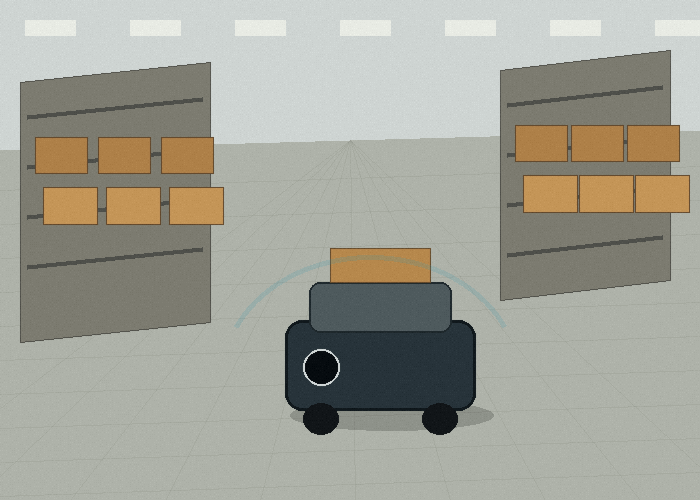
A 2D LiDAR sensor for AMR navigation should be chosen around the route, not around a clean product table. The real warehouse route includes pallet corners, rack legs, parked carts, people crossing aisles, floor tape, stretch wrap, and docking stations that may shift slightly after a busy day.
If you are comparing options in the LiDAR sensor category, begin with a route walk. Mark the turns, cross-aisles, docks, low obstacles, and places where workers naturally step into the path. That route sketch is more useful than asking for the highest possible range number.
Quick Answer: Start With The Scan Plane
A 2D LiDAR sensor reads a slice of the world. In AMR work, that slice can be powerful when it crosses the objects that matter: pallet corners, rack legs, cart frames, docking edges, or a person entering the route. If the sensor is too high, it may scan above low objects. If it is too low, floor debris and robot body reflections may create noise.
The Robotics LiDAR application page is a useful starting point for thinking about the route as a robot problem. The industrial automation LiDAR page is better when the same sensor must also fit a production or warehouse control process.
Map The Route Before Selecting Hardware
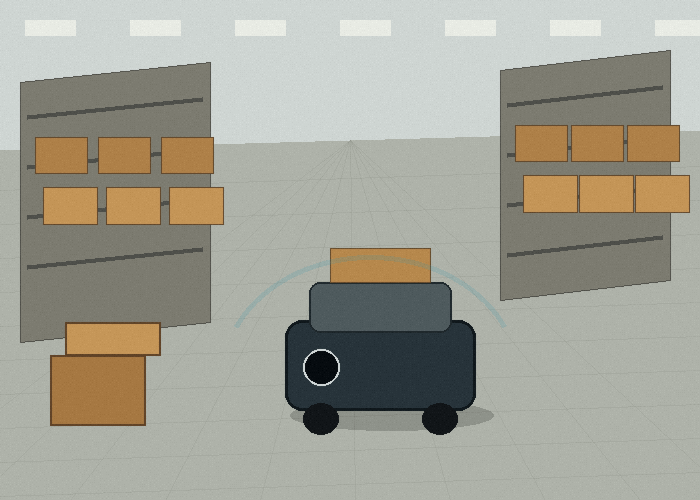
Walk the route at the same time of day the robot will work. Morning receiving may look different from afternoon shipping. A route that looks open during a demo may become crowded when pallets are staged near the dock. Write down the narrowest aisle, the sharpest turn, the most common temporary obstacle, and the point where the robot must slow down.
A good AMR sensor brief includes robot width, payload height, normal speed, stopping behavior, docking target, and the lowest object that must be detected. For a tote carrier, the important object might be a carton on the floor. For a pallet mover, the important object may be a fork pocket or pallet corner.
For basic terminology, the overview of autonomous mobile robots helps frame the difference between mobile robots and fixed automation. The general LiDAR explanation also helps non-engineering buyers understand why distance measurement is central to the decision.
| Route feature | Question to ask | Sensor decision it affects |
|---|---|---|
| Rack end | Can the scan see the vertical leg? | Mounting height and angle |
| Pallet corner | Is it visible before turning? | Detection distance |
| Cross-aisle | Can the robot slow smoothly? | Response timing |
| Docking point | Is alignment repeatable? | Reference target and software logic |
| Temporary clutter | Does it trigger useful behavior? | Filtering and zone rules |
Use Speed To Set A Useful Detection Distance
Range is not a trophy number. It is useful only when it supports the response time the robot needs. A slow AMR in a controlled aisle may need less distance than a faster vehicle crossing a shared work lane. The sensor, controller, brake response, payload, and floor condition all affect the final behavior.
Watch how the robot slows, not only whether it stops. In a warehouse, sudden stops can create their own workflow problem. Workers should be able to predict what the robot will do. A stable 2D LiDAR sensor can support smoother slowdown logic when the detection zone is tuned to the real route.
The OSHA warehousing overview notes common warehouse hazards including powered industrial trucks, material handling, slips, and robotics. That is a helpful reminder that AMR sensing is part of a broader site process, not a standalone magic layer.
Test With Normal Warehouse Imperfection
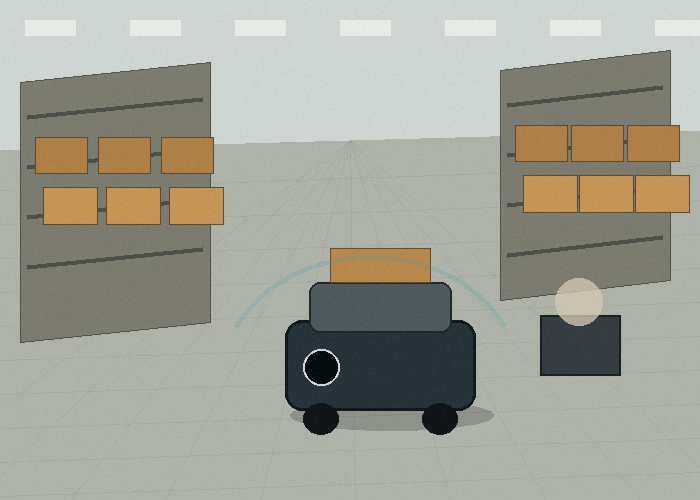
Do not test only with a clean obstacle in the middle of the aisle. Put a pallet half inside the route. Place a dark tote near a rack leg. Leave a cart handle just inside the scan plane. Let a person cross the route at a normal walking pace. These imperfect scenes show whether the sensor supports real operation.
Record the sensor view during the test if possible. Look for stable edges, repeated false triggers, missed low objects, and blind spots caused by payload. A short video with sensor output and robot movement is often enough to explain the problem to both engineering and purchasing teams.
NIST work on mobile robotics systems research and standard test methods is useful because it emphasizes performance measurement, docking, navigation, object detection, and protection. That mindset fits practical AMR purchasing: define what good performance means before scaling a fleet.
Docking Deserves Its Own Test
Docking is different from route following. The robot may need to approach a charger, conveyor, rack station, or handoff point with repeatable alignment. A 2D LiDAR sensor can help if the docking scene has features the scan can read consistently. If the dock is visually clear but poor in the scan plane, the software may struggle.
The NIST review of AGV and mobile robot docking research is a good external reference because it treats docking as a precise control task rather than a simple stop point. In real warehouses, small alignment errors can damage loads, docks, or the robot body.
For an early test, repeat docking ten to twenty times from slightly different starting positions. Note whether the robot drifts, whether the sensor sees the same reference features, and whether payload height changes the scan. If docking fails only when loaded, the issue may be view obstruction rather than navigation logic.
Integration Notes Engineers Should Not Skip
Software teams should confirm coordinate frames, update rate, filtering, timestamp handling, and error behavior. The Nav2 documentation is a useful reference for how navigation software thinks about maps, costmaps, behavior, and robot movement. Even if your system is not built on that stack, the concepts help structure test conversations.
Once the route and integration needs are clear, shortlist sensors by scan angle, output, physical size, and mounting protection. If the project may later need richer perception, keep the 3D LiDAR sensor category in view for future stages.
Build A Small Field Notebook
A good 2D LiDAR sensor project benefits from a small field notebook. It can be a spreadsheet, a shared document, or a printed checklist. The format matters less than the habit. For each trial, record the scene, mounting position, target object, distance, speed, lighting, and whether the system response felt useful.
In a a warehouse AMR route, people often remember only the dramatic pass or failure. The notebook keeps the quieter details visible. Maybe the sensor worked well with a clean pallet corner or rack leg, but struggled when the same object was angled. Maybe it worked in the morning but became noisier near a bright doorway. Those patterns are easy to forget after a long test day.
The notebook should also include photos. Take one wide photo of the whole work area and one close photo of the mounting point. If the sensor is moved, photograph the new location. If the target object is changed, photograph that too. This avoids confusion later when engineering, purchasing, and operations discuss the same test.
Separate Sensor Problems From System Problems
When a test looks bad, do not immediately blame the 2D LiDAR sensor. The problem may be mounting, cable strain, target placement, controller timing, software filtering, or the response rule. A sensor can report useful data while the robot or machine still reacts poorly.
A simple way to separate the problem is to ask three questions. Did the sensor see the object? Did the software interpret it correctly? Did the machine respond in the right way? If the answer fails at the first step, the issue may be sensor placement or sensing limits. If the answer fails at the second step, the issue may be data handling. If the answer fails at the third step, the issue may be control logic.
This matters because missed route objects or repeated nuisance stops can have several causes. Buying a different sensor may not help if the real issue is a blocked view or an unclear response rule. On the other hand, software tuning will not solve a scene the sensor physically cannot see.
Define Three Zones Instead Of One Big Zone
Many early tests use one large detection zone because it feels simple. In real work, separate zones are usually more useful. A near zone may require an immediate stop. A middle zone may call for slowdown. A wider awareness zone may simply tell the system to prepare for a possible route change.
For pallet corner or rack leg, these zones should be tied to real movement. The near zone should match the distance where contact or alignment error becomes unacceptable. The middle zone should allow a smooth response. The awareness zone should be wide enough to prevent surprise without creating constant false alerts.
Zone design should be tested with people who work near the system. Operators and floor staff know where objects actually appear. They can tell whether a warning feels early, late, or annoying. Their feedback often improves the system faster than a longer engineering debate.
| Zone | Typical purpose | What to verify |
|---|---|---|
| Near zone | Stop or strong warning | No late response at normal speed |
| Middle zone | Slowdown or careful approach | Smooth behavior without harsh braking |
| Awareness zone | Early route or operator awareness | Few nuisance alerts during normal work |
| Ignore zone | Known machine body or fixture | No repeated false trigger from expected structure |
Run The Same Test After A Small Change
One honest test is useful. The same test after a small change is more useful. Move the target object slightly. Change the payload. Shift the mounting angle by a small amount. Run the machine at a slower and then normal speed. These small changes show whether the result is stable or fragile.
In a warehouse AMR route, fragile results are common. A setup may work when the pallet corner or rack leg is centered, then become unreliable when it is near an edge. A sensor may look good when clean, then become less stable after a normal shift of dust, fingerprints, or vibration. Finding that early is cheaper than finding it after rollout.
Do not try to test every possible condition in one day. Choose the five or six conditions most likely to happen during normal work. A realistic test plan is better than a huge test plan nobody completes.
Plan For Maintenance Before The First Rollout
sensor cleaning, bracket stiffness, and cable protection should be part of the first design discussion. If the sensor window is hard to reach, it will not be cleaned often. If the bracket is easy to bend, the scan or field of view may drift. If the cable is routed through a service area, it may be pulled during maintenance.
Ask who will inspect the sensor and how often. Ask what a normal cleaning method looks like. Ask whether the operator can see obvious damage. Ask whether a replacement sensor can be installed without rebuilding the whole mount. These small questions decide whether the setup remains reliable after the first week.
For a fleet deployment, standardization matters. Use the same mounting reference, cable route, and inspection checklist when possible. If each unit is installed slightly differently, troubleshooting becomes slower and test results become harder to compare.
Make The Decision In Stages
A practical buying decision has stages. First, decide what the sensor must notice. Second, confirm that the planned mounting position can see that zone. Third, test the response with real objects. Fourth, review maintenance. Fifth, decide whether the setup can scale across more machines or routes.
This staged approach keeps the 2D LiDAR sensor decision grounded. It also prevents a common mistake: buying hardware because it sounds advanced, then trying to invent the use case afterward. The use case should lead. The sensor should follow.
How To Review The Result With The Team
After the field test, review the result with the people who will live with the system. Engineers may focus on data quality. Operators may focus on whether the response feels natural. Maintenance staff may notice cleaning and bracket problems. Purchasing may ask whether the same setup can be repeated across future units.
Those viewpoints should not be treated as separate arguments. They are different parts of the same decision. A sensor that is accurate but hard to maintain may still fail in daily use. A sensor that is easy to mount but creates constant nuisance alerts may be ignored. A sensor that works in one carefully prepared scene may need more testing before it becomes a standard choice.
A clear review meeting ends with one of three decisions: proceed with the setup, change the mounting or rules and retest, or choose a different sensing approach. That simple decision structure keeps the project moving without pretending that one test answers everything.
What To Send Before You Ask For A Recommendation
A useful inquiry is short but specific. Send the work scene, the moving object, the target detection zone, the expected response, the mounting space, and the controller interface. The LidarStar quote request page is the best place to include those details because it keeps the product discussion tied to the real application.
Photos help more than long descriptions. A front view, side view, mounting close-up, route view, and one short phone video can reveal blind spots, cable limits, reflection risks, and working distances that are easy to miss in a written message.
If the project has more than one stakeholder, include one sentence about each person’s concern. Operations may care about fewer stops, engineering may care about stable data, maintenance may care about cleaning access, and purchasing may care about repeatability. A recommendation is stronger when it answers all of those concerns without turning the project into a vague wish list. This also makes later comparison between candidate sensors much easier and keeps the project notes readable.
Buying Checklist
| Question | What a useful answer looks like |
|---|---|
| What must the sensor detect? | Objects, distances, surfaces, and the zone that matters |
| Where can it be mounted? | A protected position with a clear view |
| What happens after detection? | Warning, slowdown, stop, map update, or alignment |
| What environment must it survive? | Dust, vibration, light, temperature, or cleaning limits |
| What data does the controller need? | Interface, update rate, coordinate frame, and test method |
FAQ
Is a 2D LiDAR sensor always the best choice?
No. It is the right choice only when its sensing style matches the work scene. The best project starts with the task, not with a product label.
How many field tests are enough?
Run at least one clean test, one cluttered test, one lighting or surface test, and one normal-operation test with the real movement pattern.
Should I compare only range numbers?
No. Range matters, but scan coverage, mounting height, response time, object surface, and integration details often decide whether the sensor works well.
Can one sensor solve every blind spot?
Sometimes, but not always. If the machine or robot has several risk zones, the layout may need multiple sensors or a different sensing layer.
What is the safest next step?
Document the scene, choose a candidate sensor, run a small controlled test, and only then decide whether to scale the same setup.