Flash LiDAR service robot navigation is a practical engineering question, not just a definition. The short answer is that the right sensor is the one that measures the required target with enough range, timing, confidence and software compatibility for the machine to act. Start with the job, validate against authoritative references such as time-of-flight camera concept, and compare the result with LidarStar LiDAR sensor engineering resources only after the operating conditions are clear.
For a buyer, integrator or engineering manager, the safest path is to write a small acceptance test before choosing hardware. That test should name the target size, surface, distance, speed, field of view, mounting location, output message and required response. If the project involves robots, vehicles or industrial equipment, LidarStar LiDAR sensor catalog and neutral LiDAR technology overview give useful context for matching product capability to the real environment.
This guide uses Flash LiDAR service robot navigation as the organizing question and turns it into a decision workflow. It avoids static price claims and unsupported performance promises because every deployment changes the result. Instead, it focuses on measurable field behavior, practical specifications, current public technical references and the type of evidence a team can reuse during procurement, integration, maintenance and troubleshooting.
Flash LiDAR service robot navigation decisions become clearer when the team begins with a measurable job instead of an abstract sensor preference. In this early stage, define the target, distance, motion, mounting height, software output and response time before comparing any specification sheet. A practical team will also keep Nav2 collision monitor documentation nearby for terminology and measurement context, then map the required behavior to LiDAR sensor product families so the sensor choice stays tied to a real LidarStar application path.
The second discipline is separating the raw measurement from the final machine action. Raw data may look stable, while the filtered output or controller behavior still fails under vibration, glare, occlusion or a low-reflectivity target. This is why a useful test saves raw frames, interpreted objects and the final stop, warning, map update or control message together. The same evidence can be used when discussing 2D LiDAR sensor options, and it should be compared with neutral measurement guidance such as ROS 2 PointCloud2 message documentation.
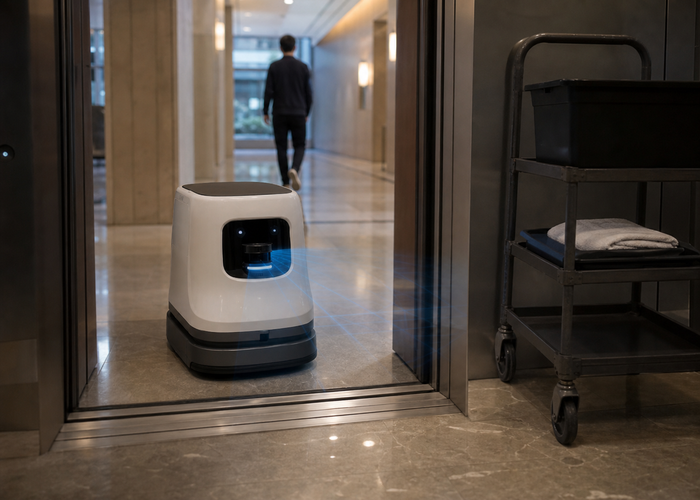
Doorways and elevator thresholds are hard because the robot has to read depth
Doorways and elevator thresholds are hard because the robot has to read depth, floor edges, moving people and tight side clearances at the same time. Treat this as a field question. Build a short route or bench setup that includes the target surface, motion, lighting, vibration and software pipeline expected in production. Reference material such as Nav2 collision monitor documentation helps keep measurement terms grounded, but the pass condition should be written in the language of the machine: detect, localize, slow, stop, map, count or inspect. For teams choosing hardware, LiDAR sensor product families is a practical place to connect that behavior to available sensor families.
A common mistake is approving the first clean demonstration. Clean demonstrations hide low-sun glare, dark targets, glass edges, wet surfaces, airborne dust, angled mounting, cable strain and compute load. Run at least one positive case, one negative case and one degraded case. Save a screenshot only after the raw log and configuration are saved. When an environmental or safety claim matters, cite a source near the claim and then reproduce the condition locally before freezing the design.
The output format also matters. A planner that expects a planar scan will not benefit from a dense cloud until the conversion, filtering and timing are correct. A perception model that expects a cloud needs frame IDs, timestamps, units and invalid-return handling that stay consistent. Before requesting volume deployment, repeat the test after reboot, after cable movement and after a cleaning or service step. That evidence is more useful than a generic comparison table.
Flash LiDAR can be useful when a robot needs a compact depth view at close range instead of a long spinning scan
Flash LiDAR can be useful when a robot needs a compact depth view at close range instead of a long spinning scan. Treat this as a field question. Build a short route or bench setup that includes the target surface, motion, lighting, vibration and software pipeline expected in production. Reference material such as ROS 2 LaserScan message documentation helps keep measurement terms grounded, but the pass condition should be written in the language of the machine: detect, localize, slow, stop, map, count or inspect. For teams choosing hardware, 2D LiDAR sensor options is a practical place to connect that behavior to available sensor families.
A common mistake is approving the first clean demonstration. Clean demonstrations hide low-sun glare, dark targets, glass edges, wet surfaces, airborne dust, angled mounting, cable strain and compute load. Run at least one positive case, one negative case and one degraded case. Save a screenshot only after the raw log and configuration are saved. When an environmental or safety claim matters, cite a source near the claim and then reproduce the condition locally before freezing the design.
The output format also matters. A planner that expects a planar scan will not benefit from a dense cloud until the conversion, filtering and timing are correct. A perception model that expects a cloud needs frame IDs, timestamps, units and invalid-return handling that stay consistent. Before requesting volume deployment, repeat the test after reboot, after cable movement and after a cleaning or service step. That evidence is more useful than a generic comparison table.
Comparison Table
Tables are useful only when they help a team make a defensible field decision. Use the table below as a starting point, then replace each generic check with the actual route, surface, speed and software output in your project. Product planning should keep each row tied to a measurable pass condition.
| Indoor obstacle | Why it is difficult | Useful validation |
|---|---|---|
| Elevator threshold | Small height change near reflective doors | Slow approach and no wheel hesitation |
| Housekeeping cart | Irregular shape and thin legs | Robot routes around it without clipping |
| Glass wall | Reflective or weak depth return | Planner treats the boundary consistently |
| Walking person | Changing distance and occlusion | Smooth slow-down without sudden stop |
| Door frame edge | Narrow side clearance | Repeat turn without scraping margin |
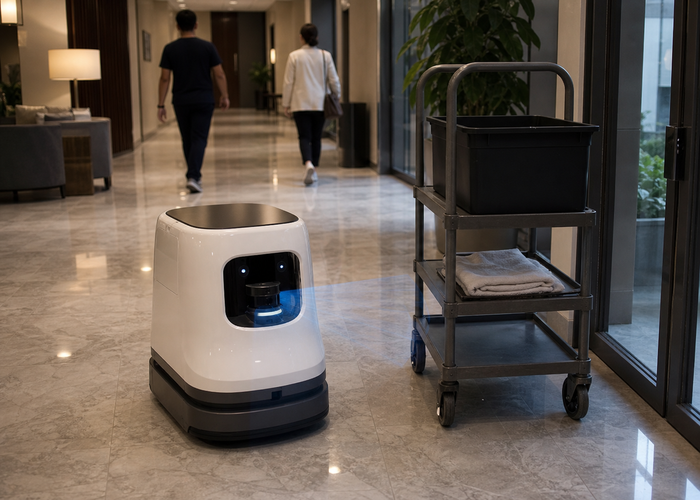
The test route should include carts
The test route should include carts, reflective elevator doors, dark mats, glass walls and people crossing at normal walking speed. Treat this as a field question. Build a short route or bench setup that includes the target surface, motion, lighting, vibration and software pipeline expected in production. Reference material such as NIST ranging tests for laser scanners helps keep measurement terms grounded, but the pass condition should be written in the language of the machine: detect, localize, slow, stop, map, count or inspect. For teams choosing hardware, 3D LiDAR sensor options is a practical place to connect that behavior to available sensor families.
A common mistake is approving the first clean demonstration. Clean demonstrations hide low-sun glare, dark targets, glass edges, wet surfaces, airborne dust, angled mounting, cable strain and compute load. Run at least one positive case, one negative case and one degraded case. Save a screenshot only after the raw log and configuration are saved. When an environmental or safety claim matters, cite a source near the claim and then reproduce the condition locally before freezing the design.
The output format also matters. A planner that expects a planar scan will not benefit from a dense cloud until the conversion, filtering and timing are correct. A perception model that expects a cloud needs frame IDs, timestamps, units and invalid-return handling that stay consistent. Before requesting volume deployment, repeat the test after reboot, after cable movement and after a cleaning or service step. That evidence is more useful than a generic comparison table.
A good indoor navigation setup checks whether the robot slows smoothly before the threshold rather than making a late correction
A good indoor navigation setup checks whether the robot slows smoothly before the threshold rather than making a late correction. Treat this as a field question. Build a short route or bench setup that includes the target surface, motion, lighting, vibration and software pipeline expected in production. Reference material such as ROS 2 pointcloud-to-laserscan package helps keep measurement terms grounded, but the pass condition should be written in the language of the machine: detect, localize, slow, stop, map, count or inspect. For teams choosing hardware, robotics LiDAR applications is a practical place to connect that behavior to available sensor families.
A common mistake is approving the first clean demonstration. Clean demonstrations hide low-sun glare, dark targets, glass edges, wet surfaces, airborne dust, angled mounting, cable strain and compute load. Run at least one positive case, one negative case and one degraded case. Save a screenshot only after the raw log and configuration are saved. When an environmental or safety claim matters, cite a source near the claim and then reproduce the condition locally before freezing the design.
The output format also matters. A planner that expects a planar scan will not benefit from a dense cloud until the conversion, filtering and timing are correct. A perception model that expects a cloud needs frame IDs, timestamps, units and invalid-return handling that stay consistent. Before requesting volume deployment, repeat the test after reboot, after cable movement and after a cleaning or service step. That evidence is more useful than a generic comparison table.
Flash LiDAR service robot navigation decisions become clearer when the team begins with a measurable job instead of an abstract sensor preference. In this middle stage, define the target, distance, motion, mounting height, software output and response time before comparing any specification sheet. A practical team will also keep NIST laser scanner calibration experiments nearby for terminology and measurement context, then map the required behavior to robotics LiDAR applications so the sensor choice stays tied to a real LidarStar application path.
The second discipline is separating the raw measurement from the final machine action. Raw data may look stable, while the filtered output or controller behavior still fails under vibration, glare, occlusion or a low-reflectivity target. This is why a useful test saves raw frames, interpreted objects and the final stop, warning, map update or control message together. The same evidence can be used when discussing autonomous-driving LiDAR applications, and it should be compared with neutral measurement guidance such as NOAA LiDAR measurement overview.
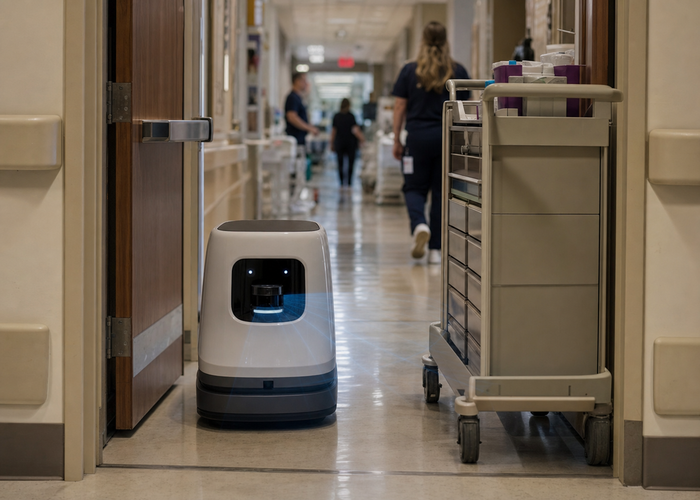
Depth data should be validated together with the planner
Depth data should be validated together with the planner, because a clean image is not the same as a safe path decision. Treat this as a field question. Build a short route or bench setup that includes the target surface, motion, lighting, vibration and software pipeline expected in production. Reference material such as NIST laser scanner calibration experiments helps keep measurement terms grounded, but the pass condition should be written in the language of the machine: detect, localize, slow, stop, map, count or inspect. For teams choosing hardware, autonomous-driving LiDAR applications is a practical place to connect that behavior to available sensor families.
A common mistake is approving the first clean demonstration. Clean demonstrations hide low-sun glare, dark targets, glass edges, wet surfaces, airborne dust, angled mounting, cable strain and compute load. Run at least one positive case, one negative case and one degraded case. Save a screenshot only after the raw log and configuration are saved. When an environmental or safety claim matters, cite a source near the claim and then reproduce the condition locally before freezing the design.
The output format also matters. A planner that expects a planar scan will not benefit from a dense cloud until the conversion, filtering and timing are correct. A perception model that expects a cloud needs frame IDs, timestamps, units and invalid-return handling that stay consistent. Before requesting volume deployment, repeat the test after reboot, after cable movement and after a cleaning or service step. That evidence is more useful than a generic comparison table.
The final sensor choice should reflect doorway width
The final sensor choice should reflect doorway width, mounting height, minimum detection distance, lighting changes and service access. Treat this as a field question. Build a short route or bench setup that includes the target surface, motion, lighting, vibration and software pipeline expected in production. Reference material such as time-of-flight camera concept helps keep measurement terms grounded, but the pass condition should be written in the language of the machine: detect, localize, slow, stop, map, count or inspect. For teams choosing hardware, industrial automation LiDAR solutions is a practical place to connect that behavior to available sensor families.
A common mistake is approving the first clean demonstration. Clean demonstrations hide low-sun glare, dark targets, glass edges, wet surfaces, airborne dust, angled mounting, cable strain and compute load. Run at least one positive case, one negative case and one degraded case. Save a screenshot only after the raw log and configuration are saved. When an environmental or safety claim matters, cite a source near the claim and then reproduce the condition locally before freezing the design.
The output format also matters. A planner that expects a planar scan will not benefit from a dense cloud until the conversion, filtering and timing are correct. A perception model that expects a cloud needs frame IDs, timestamps, units and invalid-return handling that stay consistent. Before requesting volume deployment, repeat the test after reboot, after cable movement and after a cleaning or service step. That evidence is more useful than a generic comparison table.
Field Checklist Before You Commit
Write the acceptance checklist in plain operational language. Name the object that must be detected, the distance where action must begin, the mounting position, the optical-window condition, the weather or lighting condition and the software output that triggers the final behavior. Keep one clean run and one difficult run in the project folder so later engineering teams can understand the boundary. If the project needs a product shortlist, LidarStar application solutions can turn the same evidence into a focused sensor recommendation.
Do not end the evaluation at the sensor viewer. The useful question is whether the machine makes a reliable decision when the target is partly hidden, moving, dark, wet, angled or close to the field edge. Repeat the route after reboot, after service, after cleaning and after a minor mechanical adjustment. That routine catches fragile integration before the system is copied to more vehicles, robots or sites.
Conclusion
Flash LiDAR service robot navigation should lead to a repeatable test, not a guess. Use authoritative references, real targets, production mounting, production software and a clear pass condition. When the measured result stays stable across normal and degraded conditions, the sensor choice becomes much easier to defend. That is the practical way to connect Flash LiDAR service robot navigation with a reliable LidarStar deployment.
FAQ
Why use Flash LiDAR on service robots?
It can provide compact depth information for close-range indoor navigation tasks. Confirm the answer with a short field check before finalizing the project.
Does Flash LiDAR replace all other sensors?
Usually no; it is commonly evaluated as part of a combined navigation stack. Confirm the answer with a short field check before finalizing the project.
What is the hardest doorway test?
A narrow doorway with a cart, reflective surface and moving person is often more revealing than an empty hallway. Confirm the answer with a short field check before finalizing the project.
Should elevator doors be tested separately?
Yes, because reflective metal and threshold geometry can change depth behavior. Confirm the answer with a short field check before finalizing the project.
What should buyers ask for?
Ask for sample data, mounting guidance and a field test using the robot’s real route. Confirm the answer with a short field check before finalizing the project.