
More data isn’t always better protection — sometimes it’s just more noise. The industrial automation industry has developed a serious obsession with high-resolution point cloud systems, treating raw data density as a proxy for capability. But when it comes to practical LiDAR for obstacle avoidance, that obsession carries a steep hidden cost.
Point cloud systems require entire software stacks — frameworks, SDKs, custom processing pipelines — just to interpret what the sensor captured. Each layer of that stack is another failure point, another maintenance burden, and critically, another source of delay. Research and technical benchmarking consistently show that point cloud processing introduces 50ms–200ms of latency due to software overhead alone. In a fast-moving industrial environment, that gap is the difference between a near-miss and a serious incident.
| Metric | Point Cloud System | What You Actually Need |
|---|---|---|
| Data Output | Millions of 3D points per scan | Binary: Object / No Object |
| Processing Required | External PC, ROS, SDK stack | Direct PLC-readable signal |
| Typical Latency | 50ms–200ms | <10ms |
| Complexity | High | Low |
Here’s the fundamental truth most vendors won’t say out loud: in a safety scenario, you don’t need to know the shape of the obstacle — you just need to know it’s there. Reconstructing a full 3D model of a forklift pallet is impressive. Stopping the conveyor before it hits one is what matters.
The question isn’t how many points your system can generate. It’s how fast and reliably it can act on the right signal — and that’s exactly where a simpler, smarter approach wins.
The Case for Discrete LiDAR: Speed, Simplicity, and the Binary Advantage
As the previous section established, drowning in point cloud data creates its own category of risk. The smarter alternative isn’t better data processing — it’s eliminating unnecessary processing altogether. That’s precisely the engineering philosophy behind On-Off I/O LiDAR.
Unlike traditional LiDAR systems that stream dense 3D maps to a separate computing platform, discrete LiDAR handles all decision-making directly on the sensor. It processes data on-edge, then outputs a single, clean binary signal to your PLC via standard M12 connectors — no middleware, no industrial PC required.
The binary advantage is elegantly simple: a protection zone either contains an obstacle or it doesn’t. Your PLC reads that answer in microseconds, not milliseconds.
The practical implications become clear when you compare the two workflows side by side:
| Point Cloud Workflow | On-Off I/O Workflow |
|---|---|
| Sensor streams raw 3D data | Sensor evaluates the zone internally |
| Industrial PC processes the data | PLC receives a direct binary signal |
| Software interprets object presence | No interpretation layer needed |
| Complex drivers and Ethernet protocols | Standard M12 connector, plug-and-play |
| $2,000+ computing hardware required | Zero additional infrastructure |
| Latency introduced at every handoff | Near-instantaneous machine response |
The fundamental shift here is one of focus. Point cloud systems map everything — the entire 3D environment, constantly. Discrete LiDAR defines a specific protection zone and asks one question: is something inside it or not? That constraint isn’t a limitation; it’s a feature.
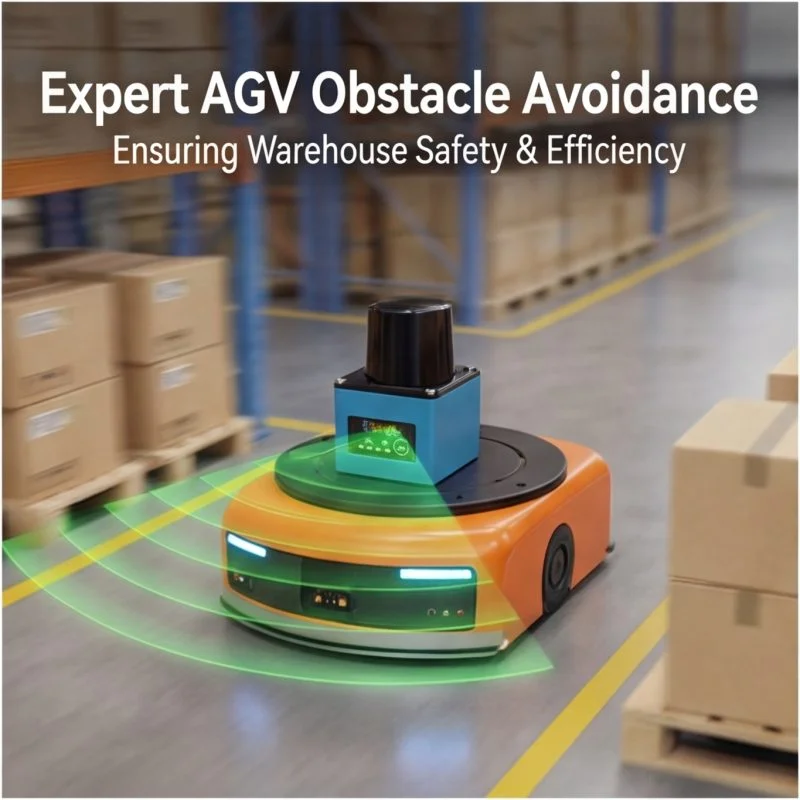
In practice, obstacle detection rarely needs a full environmental model. It needs a reliable, fast answer. Stripping the workflow down to that single output removes cost, complexity, and failure points simultaneously — which is exactly why on-off switching deserves a closer look at its core advantages.
4 Reasons to Choose On-Off IO for Industrial Environments
Building on the binary advantage established in the previous section, the argument for discrete LiDAR sensors isn’t just philosophical — it’s measurable, practical, and directly tied to cost and performance outcomes that plant managers care about.
1. Immediate Machine Stops Without Processing Overhead
When an obstacle enters a defined zone, an I/O-based LiDAR doesn’t deliberate — it switches. The output signal changes state, and the machine stops. There’s no point cloud to reconstruct, no algorithm stack to traverse. Zero-latency response is the direct result of eliminating the software layer between detection and action.
In practice, this means the gap between “obstacle detected” and “machine halted” collapses to hardware switching speeds. For AGVs operating at speed, that difference isn’t academic — it’s the margin between a near-miss and an incident report.
Fast Fact: Direct I/O switching eliminates the application-layer processing delay entirely, making hardware response speeds achievable that software-based systems structurally cannot match.
2. Integration That Doesn’t Require a Specialist
Point cloud systems typically demand Ethernet configuration, proprietary drivers, and middleware that bridges sensor data to PLC logic. discrete LiDAR sensors using On-Off IO connect the way a photoelectric sensor connects — wire it, configure the zone, and you’re done.
This simplicity has real compounding value. Fewer integration dependencies mean fewer failure points, faster commissioning, and maintenance staff who can troubleshoot without vendor support. A common pattern in industrial retrofits is that I/O-based sensors go live in hours where Ethernet-based alternatives take days.
Fast Fact: Simplified wiring and the absence of network protocol dependencies mean that I/O-based LiDAR can be maintained by standard automation technicians — no specialized networking knowledge required.
3. Built-In Resilience to Harsh Conditions
Industrial environments aren’t laboratory conditions. Dust, steam, and airborne particulates are a routine reality, and this is where on-sensor filtering delivers a meaningful edge. According to research on dust-filtering algorithms, on-edge processing is more effective at rejecting environmental noise than raw point cloud filtering applied downstream.
On-Off IO systems make a binary decision at the sensor level, using onboard logic to distinguish real obstacles from interference. The alternative — filtering contaminated point clouds after the fact — introduces both latency and the risk of false positives that trigger unnecessary shutdowns.
Fast Fact: On-edge filtering handles steam and particulate environments more reliably than post-processing approaches applied to raw point cloud data.
4. Lower CAPEX With No Infrastructure Premium
Hardware costs matter, and the numbers here are difficult to argue with. Based on procurement analysis, I/O-based LiDAR hardware runs 40–60% cheaper than full point cloud equivalents — before factoring in the network infrastructure, switches, and integration labor that point cloud deployments require.
No Ethernet backbone. No edge computing nodes. No software licensing. The total cost of ownership gap widens considerably once those downstream expenses are included.
Fast Fact: I/O-based LiDAR units cost 40–60% less than point cloud alternatives, with zero additional infrastructure investment required for deployment.
These four advantages combine to create a compelling case — but speed deserves its own closer examination. How fast is fast enough, and what happens at the hardware-to-PLC handoff? That’s where the next piece of the picture falls into place.
Zero-Latency Response via Direct PLC Switching
Speed isn’t just a performance metric in industrial safety — it’s the difference between a near-miss and a shutdown. This is where LiDAR for PLC integration using discrete on-off IO signals delivers its most compelling advantage.
When a discrete sensor trips, the output switches state directly at the hardware level, bypassing the operating system and application layer entirely. There’s no packet to parse, no software loop to complete, no middleware waiting in the queue. The PLC reads a voltage change — and acts.
On-off IO response times consistently measure under 20ms, a threshold that fundamentally changes braking physics for AGVs operating at typical facility speeds.
To put that in context: “real-time” in software means a process is prioritized — it still competes for CPU cycles. Real-time in hardware means the signal is the event. That distinction matters enormously when an AGV needs to decelerate before contact.
Those sub-20ms windows directly shrink stopping distances, reducing collision risk in ways that software-processed point clouds simply can’t match at equivalent speeds. As subsequent sections will show, this timing advantage proves decisive across several demanding real-world applications.
Use Cases: Where ‘Simple’ Beats ‘Sophisticated’
As established earlier, the speed and directness of On-Off IO signals give discrete LiDAR sensors a structural edge in demanding environments. That advantage becomes even clearer when you examine specific industrial obstacle detection scenarios where point cloud complexity actively works against you.
AGVs and AMRs: Zone-Based Safety Without SLAM
Problem: A fast-moving AGV needs to react to a forklift stepping into its path — not build a map of the warehouse floor.
Solution:
- Configure two concentric detection zones: a “Slow Down” zone (outer ring) and an “Emergency Stop” zone (inner ring)
- Each zone triggers a dedicated digital output directly to the drive controller
- No SLAM algorithm, no pose estimation, no compute overhead — just an object in a zone producing an immediate binary signal
In practice, this approach eliminates the processing lag that occurs when a navigation sensor tries to reconcile a new obstacle with an existing map. When milliseconds determine whether a 500-pound robot stops in time, that distinction matters.
Overhead Cranes: Collision Prevention in High-Dust Environments
Problem: Gantry cranes operating in steel mills, foundries, or grain facilities generate airborne particulates that saturate point cloud returns and trigger false positives constantly.
Solution:
- I/O-based LiDAR uses intensity thresholding on a single detection plane, filtering out dust scatter that would corrupt a full 3D scan
- A clean digital output signals “obstruction detected” without requiring the sensor to render a coherent environmental model first
- Maintenance teams configure protection zones once; the sensor runs reliably for months without recalibration
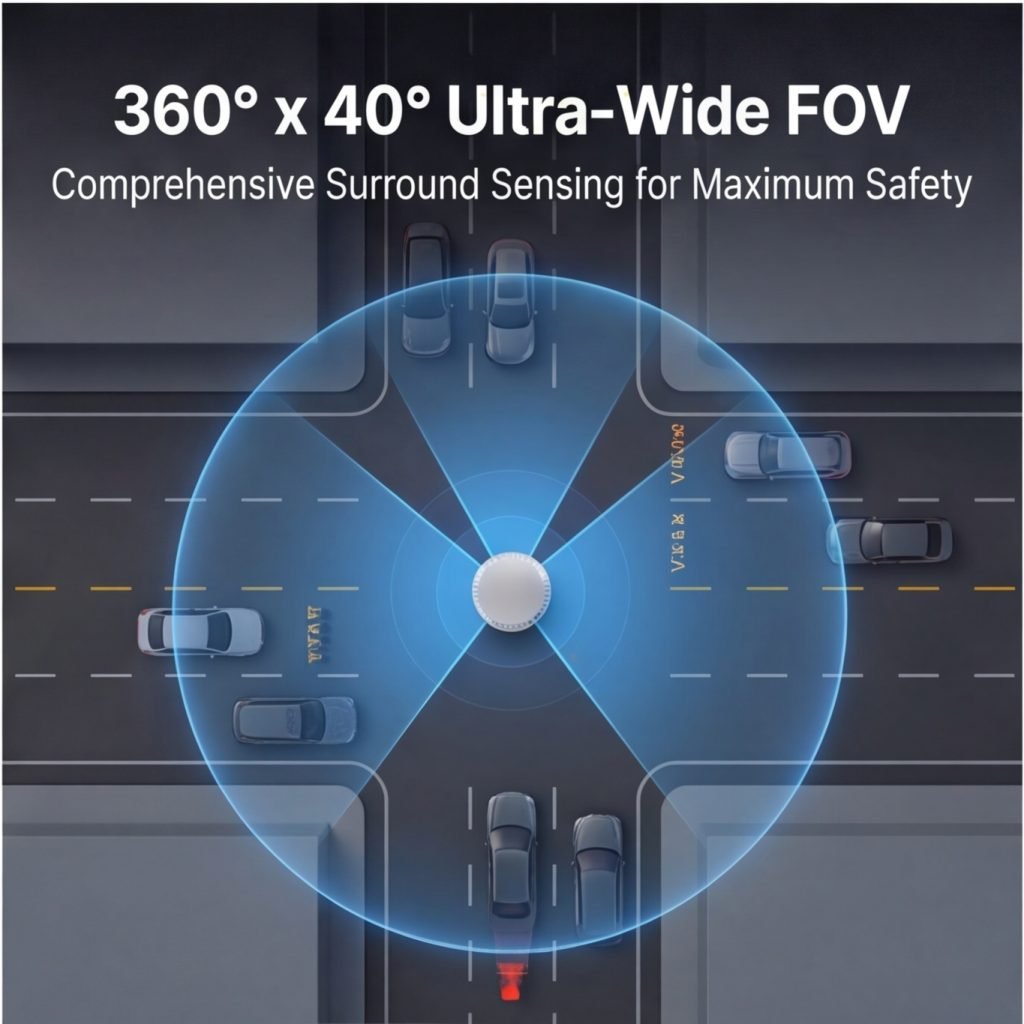
Conveyor Systems: Catching Jams at High Speed
Problem: A misaligned package or protruding flap on a high-speed sorting line can cause a cascade jam — but the detection window is measured in fractions of a second.
Solution:
- A discrete LiDAR beam positioned across the conveyor acts as a non-contact light curtain, triggering an E-stop output the instant any object breaks the plane
- No frame-by-frame point cloud analysis required; no latency from object classification
As researchers have noted, LiDAR is moving beyond passive mapping into active accident prevention — and in these high-speed, high-interference environments, that prevention depends on simplicity, not sophistication. The question isn’t whether your sensor can see everything. It’s whether it can act on what it sees fast enough.
That reliability raises a natural follow-up: how do you actually configure these protection zones without writing a line of code?
Transitioning from Complex Mapping to Reliable Detection
Effective collision avoidance sensors don’t need to be complicated — they need to be consistent. Moving from a point cloud architecture to a discrete On-Off IO system is more straightforward than most engineers expect.
The switch from algorithm calibration to a simple teach-in process can reduce installation time from days to hours.
Follow this practical setup sequence:
- Define your Protection Zone. Walk the physical area with the sensor active. Use the built-in teach-in function to set boundaries — no code, no coordinate arrays. The sensor learns the zone geometrically.
- Wire the digital I/O. Connect the sensor’s output directly to your PLC input terminal. Two wires. One signal: clear or obstructed.
- Test the trigger. Introduce an object within the zone and confirm the PLC receives the discrete signal. Adjust zone boundaries physically if needed.
One practical distinction worth noting: keep your point cloud sensor where navigation demands rich spatial data — autonomous path planning, dynamic mapping, or localization. Add a discrete I/O sensor wherever safety-critical detection is the priority. The two approaches aren’t competitors; they’re complements.
That said, every facility is different, and the right balance depends on your specific workflow — something the next section addresses directly.
Key Takeaways
- Configure two concentric detection zones: a “Slow Down” zone (outer ring) and an “Emergency Stop” zone (inner ring)
- Each zone triggers a dedicated digital output directly to the drive controller
- No SLAM algorithm, no pose estimation, no compute overhead — just an object in a zone producing an immediate binary signal
- I/O-based LiDAR uses intensity thresholding on a single detection plane, filtering out dust scatter that would corrupt a full 3D scan
- A clean digital output signals “obstruction detected” without requiring the sensor to render a coherent environmental model first
Conclusion: Choosing the Right Tool for the Job
The point cloud vs switching LiDAR debate isn’t really about technology preference — it’s about engineering discipline. Point clouds are powerful tools for mapping, navigation, and spatial analysis. On-Off I/O LiDAR sensors are purpose-built for one thing: reliable, instant obstacle detection. Confusing the two leads to over-engineered systems that are slower, costlier, and harder to maintain.
The right sensing strategy prioritizes response time and reliability over resolution. Don’t pay for data your safety logic will never use.
The future of Industry 4.0 demands smart sensing — not simply big data. Lean, deterministic detection signals are what keep machines, workers, and facilities protected at speed.
Choose the sensor that answers the question you’re actually asking.
Ready to simplify your obstacle detection stack? Explore discrete LiDAR switching sensors built for real-world industrial protection.